A 24/7 live stream is the closest thing YouTube has to owning a radio frequency: you're always on, always discoverable in the live tab, and always accumulating watch time across every time zone.But "always on" only helps if people have a reason to tune in — and stay.
Here are 12 stream concepts that actually work in 2026, with honest notes on the effort, rights issues, and monetization reality of each.One rule applies to all of them: you must own or license everything in the loop. Content ID scans live streams in real time, and YouTube's reused-content policy is unforgiving.Every idea below assumes original or properly licensed material.
Music & audio streams
1.Lofi / chill beats radio
The genre that proved the model.Viewers use these streams as background audio for studying and working, which means session times measured in hours, not minutes.The catch: the niche is crowded, so you need either your own production pipeline or commissioned tracks (producers on marketplaces will license or sell exclusive beats — get streaming rights in writing).Pair 30–60 tracks with a single animated loop or static artwork, and you have a stream that runs for months.Differentiate on a sub-niche: lofi + rain for sleep, lofi + Indian classical instruments, lofi + retro gaming visuals.
2.Sleep sounds and white noise
Rain, brown noise, fan sounds, thunderstorms — search demand is enormous and evergreen ("rain sounds for sleeping" gets searched millions of times monthly).Viewers literally leave it running 8 hours a night, which is extraordinary watch time per viewer.You can record your own rain/ambience or generate noise beds yourself.Keep the visual dark and static (people watch this in bed) and the audio bitrate decent — 192 kbps AAC minimum.
3.Genre radio for an underserved niche
Lofi is saturated; synthwave, gregorian chant, Punjabi chill, Afrobeat instrumentals, and video-game-style RPG tavern music are far less so.If you produce in any niche genre, a 24/7 radio is a permanent storefront for your catalog — and a funnel to your distributable releases on Spotify.
Ambience & visual streams
4.Ambience worlds (fireplace, café, rainy window)
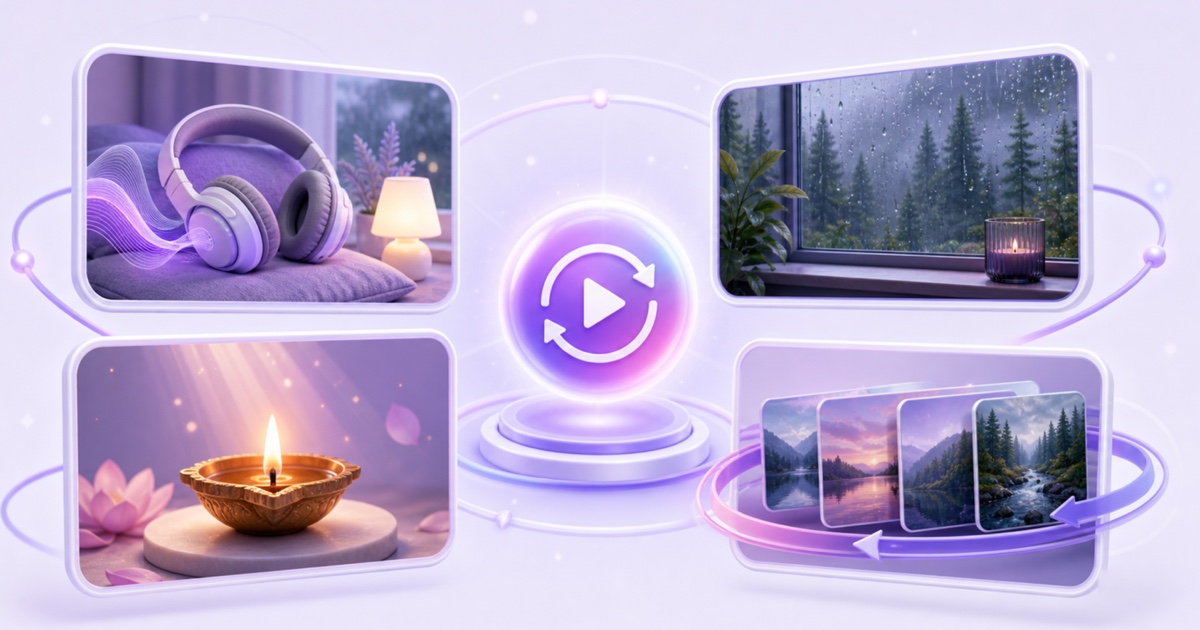
A crackling fireplace, a cozy café with rain outside, a spaceship cabin — these are 1–3 hour renders (Blender, Unreal, or filmed footage you shot) looped forever.Production is front-loaded: one great 4K render can run for a year.The audience overlaps with sleep/study viewers, and seasonal variants (monsoon, winter fireplace, Diwali-lit street) give you launch moments.Export H.264/AAC so your streaming setup can pass it through without re-encoding.
5.Nature and animal cams
Aquariums, bird feeders, beehives, a puppy playroom.If you have a genuinely live camera, this is real-time content with real fans (Explore.org built a network on it).If a permanent camera isn't feasible, film several hours of your own footage and loop it — just present it honestly as recorded ambience, not a live cam.Never re-stream someone else's webcam feed.
6.Virtual train / driving / walking journeys
Long-form POV journeys — a train through the Alps, a night drive through Mumbai, a walking tour you filmed — loop beautifully and attract a dedicated slow-TV audience.This requires footage you filmed (dashcams and gimbals make it cheap to produce).A 3-hour journey looping 8 times a day feels endless to casual viewers.
Creator & business streams
7.Podcast and interview reruns
If you have 50+ episodes of your own podcast, a 24/7 "channel radio" gives your back catalog a second life and converts drifting live-tab browsers into subscribers.Rotate the playlist monthly.This is one of the best uses of a loop for an established creator: zero new production, real discovery value.
8.Your own gameplay or esports replay channel
Speedrun attempts, ranked-match VODs, tournament replays of matches you have rights to (your own gameplay is yours; a tournament broadcast usually is not).Gaming viewers are used to background-watching streams, and a replay channel keeps your channel "live" between real streaming sessions.Label it clearly as replays.
9.Educational course loops and revision streams
A rotating loop of your tutorials — "24/7 Python interview prep," "NEET biology revision radio," "English listening practice." Students in different time zones drop in around the clock, and exam seasons create predictable traffic spikes.This works especially well in India, where exam-prep audiences are huge and mobile-first.Add timestamps of the rotation in the description so it feels navigable.
10.Product demo / behind-the-scenes channel for a business
A SaaS looping its tutorial series, a restaurant looping its kitchen b-roll and menu, a real-estate agency looping property walkthroughs.The goal isn't ad revenue — it's a permanent, zero-effort sales asset that ranks for "[your product] demo" searches.Measure it in leads, not RPM.
Data & utility streams
11.Live data dashboards
Crypto and market tickers, weather radar for your city, air-quality dashboards, live sports scoreboards (from APIs you're licensed to display).These are genuinely live — a browser or rendering script updates the data — so they dodge the "recorded loop" question entirely.Check the data provider's redistribution terms; most free APIs allow personal dashboards but not commercial rebroadcast.
12.Community events and faith services
Churches, temples, and community organizations increasingly run 24/7 channels: live services when they happen, recorded sermons/bhajans/lectures looping between them.The audience is loyal, watch sessions are long, and the content rights are yours.This model — live sometimes, looped always — is arguably the most sustainable hybrid on this list.
What separates streams that grow from streams that idle
- Serve a use case, not a topic. "Study with me," "help me sleep," "background for work" — the winners are utilities.Ask what a viewer is doing while your stream plays.
- Loop length matters. Build 1–3 hour loops minimum.Short loops feel repetitive to regulars and create thousands of loop transitions a week — a reliability risk on any setup.
- Title for search, honestly. "lofi hip hop radio 📚 beats to study/relax to" outranks clever names.Never fake liveness or use misleading "breaking" framing — that's a spam-policy violation.
- Refresh monthly. Swap tracks, update visuals seasonally.Returning viewers notice, and it strengthens your originality case if YouTube ever reviews the channel.
- Monetization is a maybe, not a plan. Live watch hours count toward YPP's 4,000-hour threshold, but acceptance depends on originality review.The reliable revenue for many 24/7 streams is indirect: music distribution royalties, channel memberships, Super Chats during live segments, leads for a business.
The infrastructure question
Every idea above needs something broadcasting continuously.A PC running OBS around the clock costs real money in electricity (~₹700/month at 120W in India) and dies with every power cut; a DIY VPS with ffmpeg is cheap but needs Linux skills.The middle path is a cloud looping service — for example, StreamNeo runs your uploaded video (up to your storage quota, resumable uploads) on its servers 24/7 with automatic crash recovery, for ₹999/month or $9.99/month per stream.If your file is H.264/AAC it streams in copy mode with zero quality loss, which matters for music and ambience channels where audio fidelity is the product.The full decision framework is in OBS vs Cloud Streaming Service, and the setup walkthrough is in How to Stream 24/7 on YouTube Without a PC.
How to validate an idea before committing
- Search the live tab for your concept.Two or three streams with 50–500 concurrent viewers = proven demand with room.Twenty streams with 5 viewers each = saturated or dead.
- Build one 60-minute loop, not a masterpiece.Test the concept before producing 10 hours of content.
- Run it for two weeks and watch concurrent viewers and average view duration in YouTube Studio.A stream that holds even 10–20 concurrents around the clock is generating 240–480 watch hours a day.
- Double down or pivot. The economics of 24/7 streaming reward iteration — your marginal cost per experiment is one video file.
If you want to run that two-week validation without buying hardware or renting a server, StreamNeo's free demo slot (email verification required) lets you put a real loop live on your channel today and see whether anyone shows up.Validate first, invest second.
More from the journal: How to Read Your Live Stream Analytics When the Stream Never Ends · The First 30 Days of a 24/7 YouTube Channel: A Day-by-Day Plan · Watch Hours From Shorts vs a 24/7 Stream: Which Path Is Faster?
FAQ
What is the most profitable 24/7 stream idea?
Per unit of effort, sleep sounds and ambience streams tend to have the best ratio — huge evergreen demand, long sessions, and content you can produce once.For direct revenue, business demo channels (measured in leads) and music radios that funnel listeners to your distributed releases usually out-earn ad revenue alone.
Can I stream movies, TV, anime, or someone else's music 24/7?
No.Content ID will flag it — often within minutes — and copyright strikes can terminate your channel.Every viable idea on this list uses content you created or explicitly licensed for streaming.
Do 24/7 streams still get monetized in 2026?
Some do.Live watch hours count toward YouTube Partner Program thresholds, but YouTube reviews channels for reused content before acceptance, and low-effort loops are routinely rejected.Treat ad revenue as upside, not the business model.
How many concurrent viewers does a new 24/7 stream get?
Expect single digits for the first weeks — discovery compounds slowly as the stream accumulates watch time and search ranking.Streams that reach 50–200 concurrents typically took months of uptime plus periodic content refreshes to get there.
How long should my loop video be?
At least 60 minutes; 2–3 hours is better.Longer loops feel less repetitive to regular viewers, and fewer loop transitions per day means fewer chances for playback glitches on whatever system is doing the streaming.
Do I need a new video every day for a 24/7 channel?
No — that's the appeal.A monthly refresh (new tracks, seasonal visuals) keeps the stream feeling alive and supports your originality standing, but the day-to-day broadcast runs itself.