
Castr and StreamNeo can both send recorded video to live platforms, but a feature checklist hides the most important difference.Castr is a broad video-broadcasting platform.StreamNeo is shaped around one recurring job: keep a creator’s recorded video playing as a live loop without leaving a computer on.
That difference affects the plan you need, the dashboard you learn, and the bill you approve.This Castr vs StreamNeo breakdown focuses on a concrete purchase question: if your destination is YouTube and the source is pre-recorded, which tool is the right size? Castr also publishes to Facebook and other platforms; StreamNeo publishes to YouTube only.
Disclosure: StreamNeo publishes this comparison, and we built one of the products being compared.Castr features and prices below were checked against Castr’s public pricing and help pages on 26 July 2026.Plans change, so confirm the checkout before paying.
Two different weight classes: a broadcast suite and a loop specialist
Think of Castr as a broadcast truck.It can accept different ingest protocols, distribute a feed to many destinations, serve video through its own player, support website embedding, and expose tools for technical teams.A 24/7 recorded loop is one load that truck can carry.
StreamNeo is closer to a scooter built for a familiar route.You upload a video, paste the destination stream key, and start the slot.The service keeps the media playing from cloud infrastructure, so your laptop and home connection are not part of the live chain.
This is not a verdict that simple always beats capable.If you run event production, need a player on your own domain, or pass feeds between broadcast systems, Castr’s larger surface is useful.If you publish a lofi playlist, bhajan loop, podcast replay, or evergreen video directly to a social channel, much of that surface may never enter your workflow.
For a wider market view, see our comparison of 24/7 pre-recorded streaming services.The sensible shortlist begins with the job, not the longest feature column.
Where Castr genuinely leads
Castr has clear advantages when the stream must do more than reach one creator channel.Its current Starter plan lists six multistream destinations; upper plans increase that allowance.Castr also includes an HTML5 player and iframe, which lets a business place its live or hosted video on its own website instead of sending every viewer to a social platform.
SRT ingest is another meaningful lead.SRT is useful when a field encoder or remote production source needs error-resilient transport into the platform.Castr’s pricing page lists SRT ingest across its main plans, and higher tiers add capabilities such as SRT or RTMP pull links, HLS delivery options, adaptive bitrate features, stream alerts, webhooks, and more advanced transcoding.
The suite also covers concerns that matter to media teams:
- Distribution: multiple social and custom destinations from one source.
- Owned playback: a customizable embeddable player, viewer analytics, chat, password protection, and player controls.
- Delivery infrastructure: CDN-backed playback with plan-specific bandwidth and storage allocations.
- Production inputs: SRT alongside familiar RTMP workflows.
- Collaboration: additional members, roles, and permissions on upper tiers.
StreamNeo does not pretend those are irrelevant.It simply does not make an embedded player, SRT ingest, or enterprise broadcast plumbing the centre of the loop-creator offer.Pick Castr when those capabilities are requirements, not just attractive possibilities on a pricing page.
Pre-recorded 24/7 on Castr: the plan and cost
Here is the money detail that is easy to miss: Castr offers pre-recorded streaming on Starter and Standard, but its current feature matrix places Infinite Loop on Premium, Ultra, and Events.It also places TV Playout Loop Mode on those same three tiers.In other words, uploading a recorded file is not the same plan entitlement as keeping it looping continuously.
Castr’s own help centre describes Infinite Loop as the mode that starts an uploaded video immediately and streams it 24/7 to added platforms.For the specific always-on loop job, Premium is therefore the first matching public tier.
| Plan | Month-to-month price | Annual effective price | Pre-recorded allowance | Infinite Loop |
|---|---|---|---|---|
| Castr Starter | $19.99/month | $16.67/month, billed $199.99 yearly | 1 concurrent stream; 4 GB | No in current matrix |
| Castr Standard | $49.99/month | $41.67/month, billed $499.99 yearly | 1 concurrent stream; 4 GB | No in current matrix |
| Castr Premium | $199.99/month | $166.67/month, billed $1,999.99 yearly | 2 concurrent streams; 10 GB | Yes |
| Castr Ultra | $349.99/month | $291.67/month, billed $3,499.99 yearly | 3 concurrent streams; 20 GB | Yes |
| Castr Events | $749.99/month | $624.99/month, billed $7,499.99 yearly | 3 concurrent streams; 20 GB | Yes |
| StreamNeo | ₹999/month in India or $9.99/month internationally | No annual commitment required | 1 continuous slot | Yes |
Sources: Castr’s current pricing matrix and its Infinite Loop scheduling guide.The comparison uses Castr Premium rather than Starter because continuous looping is the requirement being priced.

StreamNeo’s public price is ₹999 per month in India or $9.99 per month internationally for a slot.If you only need a recorded loop, that is the relevant comparison.If you need Castr’s player, SRT, CDN delivery, and production stack, comparing only the loop price understates what its Premium plan is buying.
Complexity is a cost—and sometimes the point
Castr’s documented pre-recorded flow is reasonable: create a Pre-Recorded Stream, add video, choose Infinite Loop or a scheduled time, then add platforms.The same account can also expose playout, live ingest, player, hosting, monetization, security, and analytics choices.A broadcast operator may call that control; a solo creator may call it navigation.
StreamNeo narrows the recurring path to three decisions:
- Upload the video or prepare the playlist.
- In YouTube Studio, go to Create → Go live → Stream, then copy the stream key into the slot.
- Press Go Live and check that YouTube receives the feed.
The distinction matters every time you replace media, renew a slot, or help a teammate recover a stream.Dashboard complexity is not only the minutes spent on day one; it is also the number of controls you must remember at an inconvenient hour.
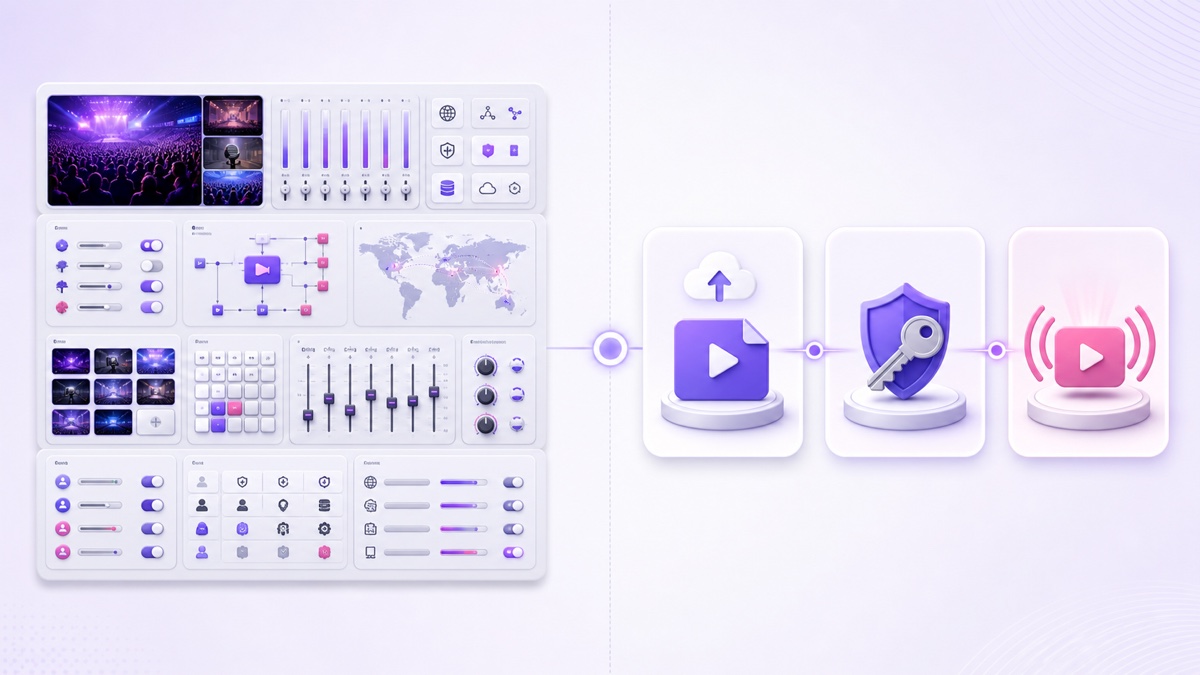
If your team genuinely uses SRT routing, website playback, paywalls, or player security, Castr’s controls repay that learning cost.If the desired output is simply a YouTube loop, StreamNeo removes decisions that do not change the result.Creators considering self-management should also compare the ongoing work in our VPS versus managed service cost guide.
India reality check
Castr displays subscription prices in US dollars.An Indian buyer therefore has to account for the card’s foreign-currency conversion, possible issuer charges, and applicable tax at checkout.Its public subscription documentation refers to updating a credit card or payment details, but we found no public promise of UPI for Castr subscription billing.Treat UPI support as unconfirmed unless it appears in your actual checkout.
StreamNeo shows the monthly creator price in rupees and routes India payments through Razorpay.That removes the need to mentally convert a dollar plan before renewing.International customers see the separate $9.99 monthly price.
Mobile usability is less about whether a page opens and more about whether the whole task is comfortable on a narrow screen.Before committing, use each trial on the phone you actually own: upload a representative file, paste a key, locate stream status, and try to replace the video.Castr’s wider capability naturally creates more places to navigate; StreamNeo’s narrower workflow is easier to complete from a mobile browser.
Recovery and monitoring compared
No vendor can prevent YouTube from rejecting an expired key, removing a live event, or applying its own platform rules.Recovery claims should separate a failed streaming process from invalid destination credentials.
Castr documents Backup Ingest on Ultra and Events.That feature requires two encoders, with the primary started first; when the primary ingest fails, Castr can switch to the backup.It is valuable for a live production source, but it is not proof that every failed push from a pre-recorded loop to a social platform will recover without interruption.
StreamNeo monitors each active streaming process.When a process exits unexpectedly, the worker retries with increasing backoff.A destination that repeatedly rejects the feed can be stopped instead of being hammered forever; the creator then needs to correct the key or destination state.That design aims for recovery from transient exits without disguising a permanent configuration problem.
Whichever tool you choose, test failure before launch: briefly interrupt a disposable test destination, rotate a test key, and confirm what the dashboard reports.Our practical guide to 24/7 auto-restart explains the difference between monitoring, retry, failover, and a false promise of zero downtime.
Decision grid: which one fits your job?
| Your actual requirement | Better starting point | Why |
|---|---|---|
| Loop recorded content to YouTube | StreamNeo | The product and price are centred on the loop job. |
| Embed a branded live player on your website | Castr | HTML5 player, iframe, player security, and CDN delivery are first-class features. |
| Ingest from an SRT encoder | Castr | SRT ingest is documented across Castr’s main plans. |
| Operate many destinations with broadcast controls | Castr | Its plan limits, routing options, and upper-tier tooling are built for that scope. |
| Run a devotional, lofi, ambience, replay, or podcast loop from a phone | StreamNeo | Fewer setup decisions and INR billing suit a solo, mobile-first workflow. |
| Run live events and a separate evergreen creator channel | Possibly both | Use Castr where the event stack is needed and a focused loop slot where it is not. |
Castr is the stronger choice when your stream is part of a larger owned-video operation.StreamNeo is the right-size choice when the stream itself is straightforward and the burden you want removed is keeping that recorded loop online.
Do not pay for theoretical future requirements.Write down today’s destinations, input type, player location, number of operators, and recovery expectation; then buy the smallest system that satisfies all five.
More from the journal: Castr 24/7 Limits Explained: File Caps, Storage and Pre-Recorded Streams · LiveReacting vs StreamNeo: Hourly Credits or Continuous Days? · StreamLoop vs StreamNeo: Usage-Based Billing vs Prepaid Days
FAQ
Does Castr support 24/7 looped streams?
Yes.Castr’s help centre documents an Infinite Loop mode for 24/7 pre-recorded streaming.Its pricing matrix checked on 26 July 2026 includes Infinite Loop on Premium, Ultra, and Events, not Starter or Standard.Premium is the first matching tier at $199.99 month-to-month or $166.67 per month equivalent when billed $1,999.99 yearly.
Is StreamNeo cheaper than Castr for looping?
For the specific continuous-loop requirement, yes.StreamNeo is ₹999 monthly in India or $9.99 monthly internationally, while Castr’s first current Infinite Loop tier is Premium.That does not mean Castr is overpriced; Premium also buys broader broadcasting, player, delivery, and production features.
Who should pick Castr?
Pick Castr if you need to embed playback on your own site, ingest SRT, distribute to many destinations, apply player security or monetization, or coordinate a broadcast team.If your job is a pre-recorded social-platform loop, test the focused alternative first.Start free — 24-hour trial, no card.