A Tamil devotional live stream should not feel like a Hindi channel with translated labels.The repertoire, pronunciation, daily rhythm, festival calendar, and comment culture all need to sound local.The same applies to a Telugu devotional channel: regional trust comes from getting the details right, not merely adding a language keyword.
This playbook shows how to build an always-on channel from recordings you own, package it for native-language discovery, and run distinct morning, daytime, evening, and night blocks.It is meant for individual creators, local singers, bhajan groups, and small devotional media teams working mainly from a phone.
The regional opportunity
Hindi devotional live streams are easy to find.Tamil and Telugu searches often return a mix of uploads, label compilations, temple broadcasts, and a smaller number of genuinely continuous regional channels.That is an opening for a focused creator, but it is not proof of guaranteed demand.Validate it with search suggestions, comments on related videos, and a four-week pilot before expanding your catalog.
Start narrower than “South Indian devotional.” A channel that clearly serves Tamil Murugan traditions or Telugu Venkateswara devotees gives viewers a stronger reason to return than a mixed-language playlist with no dependable identity.If you need the broader operating foundation first, use the 24/7 bhajan and devotional channel playbook.
The diaspora also extends your useful clock.For example, 5:30 a.m.IST is 7:00 or 8:00 p.m.on the previous day in US Eastern time, depending on daylight saving.Likewise, 11:30 p.m.IST is 6:00 or 7:00 p.m.in the UK.A morning block in Chennai can therefore serve an evening listener abroad; always check the current offset before promoting a timed programme.
Content that works per language
Choose a repertoire by tradition first, then by recording availability.Do not begin with a famous track and hope copyright will be manageable later.Begin with works your artists can perform confidently, decide the order and daypart, and commission a fresh master for the channel.
Tamil programming ideas
Vinayagar Agaval is a Tamil devotional hymn associated with Avvaiyar and addressed to Vinayagar.Kanda Sashti Kavasam is a Tamil hymn to Murugan composed by Devaraya Swamigal.Thiruppugazh refers to the Tamil devotional songs of Arunagirinathar in praise of Murugan.These are different bodies of work, so do not flatten them into a generic “Tamil mantra” label.
A practical Tamil wheel might open with a Vinayagar segment, move into measured Murugan hymns, include short spoken meanings in Tamil, and close with a softer instrumental reprise.Record the spoken introductions too; they make your version more useful and more recognisably yours.
Telugu programming ideas
Venkateswara Suprabhatam belongs naturally in the morning listening habits of many Telugu-speaking homes, but label it accurately: the hymn is in Sanskrit, not Telugu.The official Tirumala Tirupati Devasthanams description identifies Suprabhatam as a Sanskrit term and describes the early-morning recitation at Tirumala.
For Telugu-language depth, build around Annamacharya keerthanas, Telugu explanations, locally written invocations, and credited performances.A good block can pair a short spoken introduction with two or three keerthanas and a calm instrumental bridge.Avoid presenting every Venkateswara item as “Telugu” merely because it is popular in Andhra Pradesh and Telangana; state the actual language of each piece.
In both languages, the underlying composition and a particular sound recording are separate things.An old devotional work may be outside copyright while a modern singer’s performance, arrangement, studio master, and video remain protected.Your safest asset is a recording made specifically for your channel.
Rights and temple sensitivities
Treat famous commercial renditions as unavailable unless you have a licence that explicitly covers continuous online streaming, monetisation, and the countries where the stream will appear.Buying a download, subscribing to a music service, or finding an audio file on a messaging group does not grant broadcast rights.
India’s Copyright Office handbook explains that a musical sound recording can involve rights held by the lyricist, composer, singer, musicians, and producer.YouTube also says that live streams are scanned for third-party copyrighted content and may be interrupted when a match is found.A devotional purpose does not remove those rights.
The clean route is to record a local singer or commission a small ensemble, then keep a signed agreement covering:
- the singer’s performance and the final sound-recording master;
- permission to edit, loop, stream live, archive, and monetise the recording worldwide;
- the term of permission, payment or royalty terms, and the exact credit line;
- ownership or licensed use of backing tracks, arrangements, lyrics, images, and video;
- who may register the master with Content ID and how your channel will be allowlisted.
Have a lawyer review the agreement if ownership is unclear or the project is commercially significant.For a simple commission, plain written terms are still far safer than a verbal understanding.
Do not copy a temple’s live feed, television telecast, or social-media broadcast.Treat it as off-limits unless the institution gives you express written permission for your exact streaming and monetisation use.Even when you filmed at a temple, venue permission does not automatically transfer the music, performer, broadcast, or artwork rights captured in the video.
The same discipline applies to a Hanuman Chalisa loop: tradition may be shared, but a specific modern recording is not yours merely because the prayer is familiar.
Native-script SEO that still reads naturally
Put the native script first because it immediately tells the viewer the channel is for them.Follow it with a clear transliteration, not a pile of alternate spellings.Keep “Live 24/7” near the end rather than leading with it.
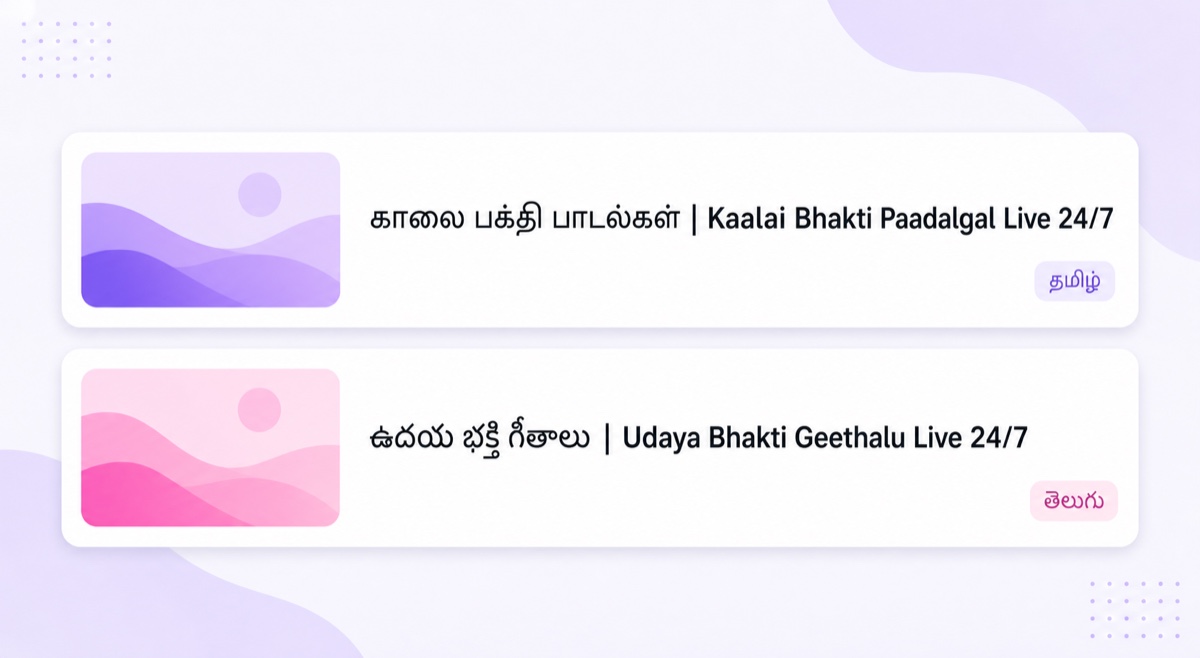
Tamil: காலை பக்தி பாடல்கள் | Kaalai Bhakti Paadalgal Live 24/7
Telugu: ఉదయ భక్తి గీతాలు | Udaya Bhakti Geethalu Live 24/7
Use the first two description lines to explain what is playing and that it is recorded.For example: “Recorded Tamil devotional programme streaming continuously.புதிய உள்ளூர் கலைஞர்களின் பதிவு.” A Telugu version can use: “Recorded Telugu devotional programme streaming continuously.స్థానిక కళాకారుల రికార్డింగ్.” Ask a fluent native speaker to review every title, description, thumbnail, and pinned comment before publishing.
Then add searchable specifics naturally: the tradition, singer’s name, language, morning or evening intent, and whether the programme is a commissioned studio recording.Do not claim that the stream is a live temple ritual.“Recorded recitation streaming continuously” is both clear and respectful.
Use festivals as planning anchors
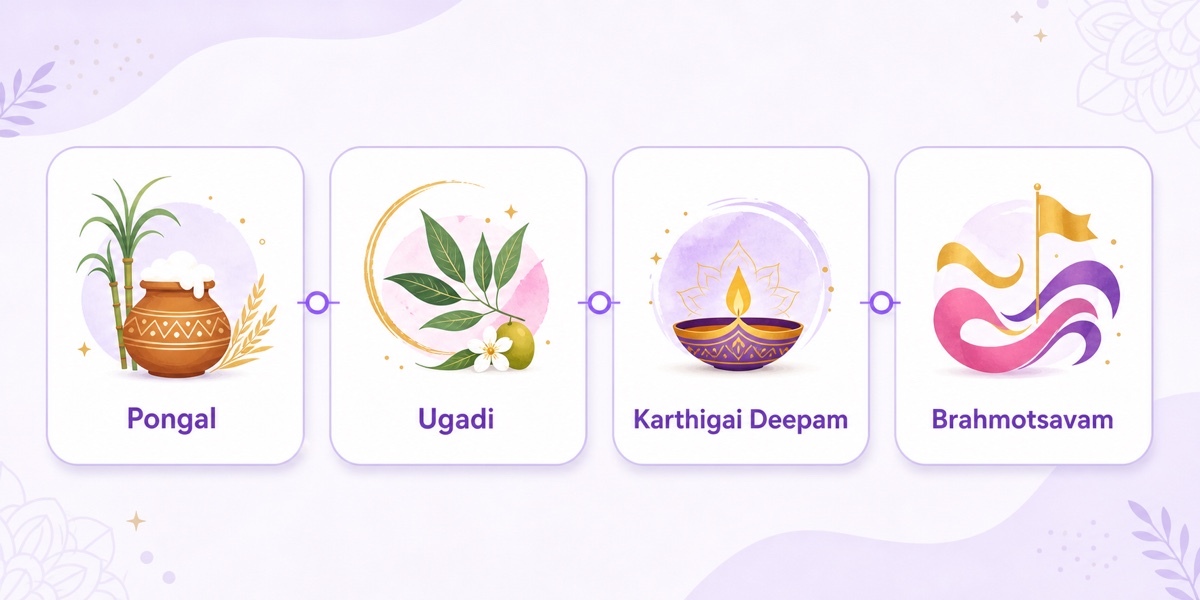
Build a rolling calendar around Pongal, Ugadi, Karthigai Deepam, and the Brahmotsavam season where they fit your audience.Festival dates can shift each year, so verify them against a reliable regional calendar before scheduling.Prepare the recording, thumbnail, title, and community posts three to four weeks early instead of changing the channel on the festival morning.
Match the anchor to the channel rather than forcing every festival into both languages.Pongal and Karthigai Deepam can shape Tamil programming; Ugadi and major Venkateswara festival periods can guide Telugu programming.A focused special is better than an unrelated keyword added for search traffic.
Setup and dayparts
A daypart system makes one channel feel intentional without pretending that every segment is happening live.Start with a simple four-block wheel and adjust it after you can see when your own viewers return.
| IST block | Programming role | Example material |
|---|---|---|
| 4:30–8:00 a.m. | Morning opening | Suprabhatam, Vinayagar opening, gentle invocations |
| 8:00 a.m.–5:00 p.m. | Daytime listening | Keerthanas, Thiruppugazh selections, spoken meanings |
| 5:00–10:00 p.m. | Evening devotion | Deeper vocal sets, festival specials, community requests |
| 10:00 p.m.–4:30 a.m. | Soft overnight block | Low-intensity vocals and instrumental devotional music |
These are programming suggestions, not ritual rules.Adapt them to the repertoire, singer, and community you actually serve.The detailed 24/7 stream schedule guide explains how to turn the wheel into a repeatable viewer promise.
For production, export a clean 1920×1080 MP4 using H.264 video, AAC audio at 48 kHz, and a constant frame rate.A 60–120 minute master reduces obvious repetition compared with a tiny clip.Listen across every join with headphones and keep voice levels consistent between artists.
- In YouTube Studio, open Create → Go Live → Stream, create or select the broadcast, and copy its stream key.Treat that key like a password.
- On StreamNeo, upload the master or build the ordered playlist, add YouTube as the destination, paste the key, enable continuous looping, and set the intended schedule.
- Start as unlisted, let the programme cross at least one loop boundary, and check audio, title, thumbnail, and picture on both a phone and a television or desktop.
- Make the YouTube broadcast public only after the test is clean.Keep the rights agreement, source masters, export, and title sheet together in one project folder.
The phone dashboard is useful for regional teams in which the singer, editor, and channel manager are not sitting at one computer.India pricing is ₹49 per day or ₹999 per month per slot; use the current pricing page before choosing a short festival run or an ongoing channel.
Respect and community
Devotional presentation needs restraint.Use a diya, kolam, flowers, calligraphy, licensed temple architecture, or a clean lyric card rather than an AI-generated deity image that may distort sacred details.Credit every singer and musician in the description and repeat the credit in a pinned comment.
Moderate prayer requests gently, remove spam without mocking the poster, and never turn a viewer’s personal situation into a promotional testimonial.Avoid miracle, health, money, or guaranteed-benefit claims in titles and thumbnails.If a segment is recorded, call it recorded; continuous delivery does not make the underlying performance live.
Assign at least one fluent Tamil or Telugu moderator for the language you serve.Check the channel daily for audio failure and copyright notices, review the schedule weekly, and refresh festival metadata only when it remains accurate.Those habits build more trust than a crowded “LIVE NOW” graphic.
If your rights-cleared regional programme is ready, Start free — 24-hour trial, no card.
More from the journal: 24/7 YouTube Streaming: The Complete 2026 Guide · 24/7 Bhakti Sangeet Channels in Regional Languages: A Complete Playbook · The Indian Festival Calendar for 24/7 Channels: Planning a Year of Loops · FAST Channels Explained for Creators: Linear TV Without a Broadcaster
FAQ
Can I use famous Suprabhatam recordings?
Not without the necessary rights.The hymn and a famous modern rendition are not the same asset: the singer’s performance, arrangement, and master recording can be protected.Commission your own version or obtain a written licence that covers continuous live streaming, monetisation, territories, and Content ID handling.
Which language should titles use?
Put the audience’s native script first, then add a clear English transliteration.Use Tamil for a Tamil channel and Telugu for a Telugu channel; identify Sanskrit items such as Venkateswara Suprabhatam accurately instead of relabelling them by market.
Does the diaspora matter?
Yes.Early morning IST can overlap with the previous evening in North America, while late-night IST can overlap with evening in the UK.Account for daylight-saving changes, study your own analytics, and promote the daypart in both IST and the relevant overseas time zone.