Yes, you can run a 24/7 channel built around AI-generated music. That does not mean every generated track is cleared for commercial streaming, every channel must be monetised, or every distributor will accept the catalogue. Those are separate decisions made under separate rules.
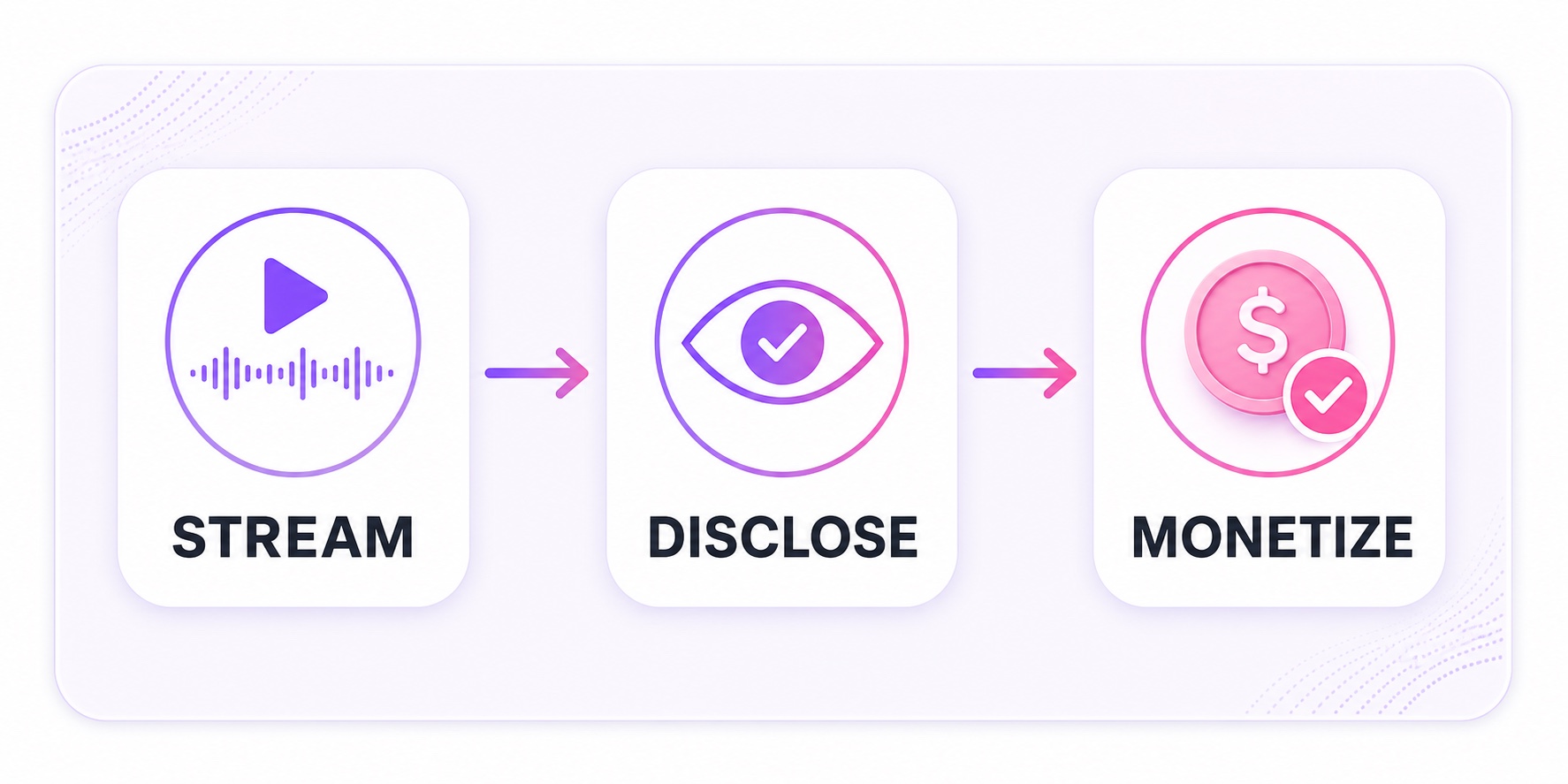
The practical answer to AI music YouTube monetization is therefore conditional: confirm your rights first, disclose the synthetic music, then give YouTube evidence that the channel contains real creative work rather than automated volume. A folder of forty one-click exports may be technically streamable and still fail a monetisation review. A smaller set that you selected, arranged, mixed, documented and art-directed has a much stronger story.
This guide reflects publicly available policies checked on 26 July 2026. Tool terms, platform labels and local law can change, so re-check the linked sources before publishing a catalogue or spending money around it.
Separate the three questions before you press Go live
Most bad advice treats “allowed” as one switch. In reality, your channel has to pass three different tests:
| Question | Who decides? | What you need |
|---|---|---|
| May I stream this track? | The generator’s licence, other rightsholders and platform content rules | Commercial and livestream rights for every audio and visual element |
| Must I disclose AI use? | YouTube’s synthetic-content policy | An accurate Altered content selection and plain description note |
| Will the channel be monetised? | YouTube Partner Program review | Original, authentic work that is not mass-produced or repetitive |
A “yes” in one row does not answer the others. A paid generator licence may allow commercial use, but it cannot promise YPP approval. Likewise, YouTube says making the synthetic-content disclosure does not by itself reduce audience reach or monetisation eligibility. Disclosure is a transparency control, not a punishment.
Question 1: rights and copyright start with the tool’s licence
Read the terms that applied when each track was generated. A plan upgrade tomorrow may not repair yesterday’s output. Also check whether the licence permits commercial use, broadcast or livestream use, distribution, modification, and use outside the generator’s own platform.
Suno is a useful example because its tiers differ. In its rights guidance and terms, checked 26 July 2026, Suno says tracks made while subscribed to Pro or Premier receive commercial-use rights and that the user is considered the owner. Basic-tier output is limited to personal, non-commercial use, and a later subscription does not automatically make the earlier tracks commercial. The terms also warn that an output may not be unique and make no promise that copyright will vest in it.
That distinction matters. Permission from a tool is not the same as copyright protection, exclusivity, or guaranteed monetisation. Keep a chain-of-title folder for every release:
- the generator name, plan and terms URL;
- the creation date, prompt history and generation record;
- the subscription invoice or receipt covering that date;
- your downloaded source, stems and project files;
- records for any samples, lyrics, voices, field recordings and artwork.
Your inputs need clearing too. Do not upload lyrics you copied, an unlicensed sample, or another person’s voice and assume the output becomes safe. Avoid prompts and metadata that impersonate a living performer. If a model produces a suspiciously familiar melody or vocal phrase, leave it out. For a wider music-rights checklist, read music you can legally stream 24/7.
Question 2: disclose the generated music
YouTube’s current altered or synthetic content guidance explicitly lists “synthetically generating music” as an example that creators need to disclose. That means a fully generated instrumental ambient or AI lofi loop sits inside the published example; it is not exempt merely because it has no cloned singer or fake news footage.
In YouTube Studio, open the content or broadcast details and set Altered content to Yes. On mobile, the documented upload path is Add details → Altered content. Because live-control layouts can move, confirm the choice on the broadcast’s details page before starting and verify that the resulting disclosure appears in the expanded description.
Add a human-readable note as well. For example: “This continuous set includes music generated with [tool], selected, arranged, mixed and mastered by [channel]. Visuals are original. No performer’s voice was cloned.” Change that sentence to match the truth. YouTube may use a title or description statement as a signal, but a note is not a reason to skip the Studio setting.
Do not hide AI use behind a fictional band biography. A made-up project name can be an artistic identity, but inventing a performer, studio session or instrumental performance that never happened crosses into deception. Honest credit is simpler and more durable.
Question 3: monetisation is where low-effort channels fail
YouTube calls the relevant YPP rule inauthentic content. The channel monetisation policy was renamed from “repetitious content” on 15 July 2025 to clarify that repetitive or mass-produced material has long been ineligible. Current examples also flag generic AI output made from unoriginal templates without the creator’s authentic perspective.
This is a channel-level review, not a detector asking whether one file used AI. Reviewers may inspect the main theme, newest and most-viewed videos, the content producing most watch time, metadata and the About section. Publishing dozens of nearly interchangeable “AI chill mix” videos can therefore weaken the whole application even if every track came from a paid plan.
A continuous stream repeats by design, but repetition alone is not the whole test. Ask what a reviewer can identify as your contribution and why a viewer would choose this set over another batch made from the same prompt. If the only answer is “it runs all day,” the work is close to the policy’s danger zone. See the broader guide to monetising a 24/7 loop for the distinction between technical eligibility, YPP entry and individual video review.
Generation speed is not creative value. Your defensible contribution is visible in the choices you made after the model returned an output.
What meaningful human contribution looks like
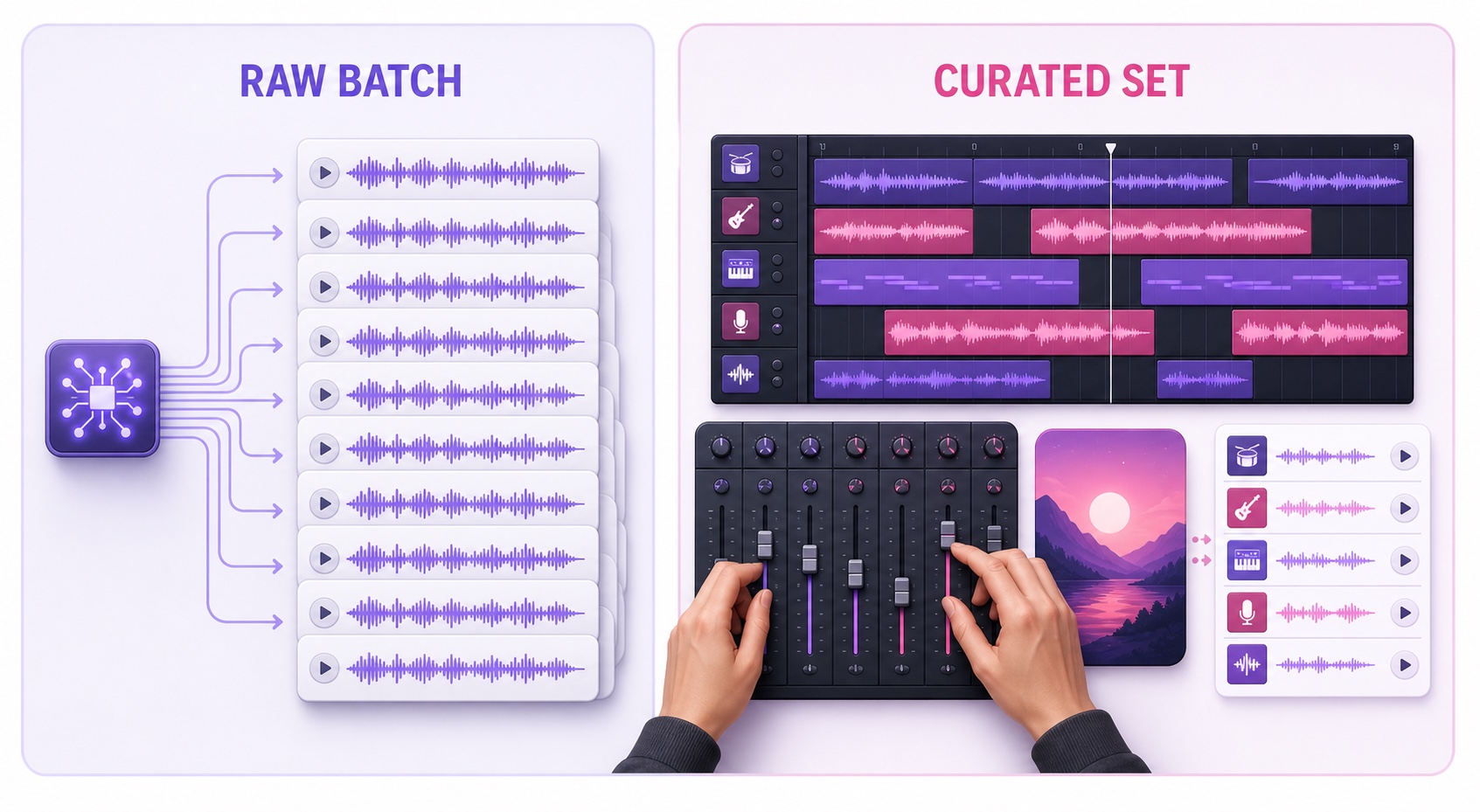
Start by rejecting most generations. Curate for a specific listening job: quiet coding, monsoon reading, late-night focus, or a devotional-adjacent ambient set that does not imitate a known singer or borrow a protected bhajan recording. Selection becomes meaningful when the tracks support a stated experience rather than merely filling minutes.
Then do production work listeners can hear. Edit weak intros, build transitions, remove artifacts, balance tonal range, control harsh peaks, match perceived loudness and master the block as one journey. If the generator offers stems, reshape the arrangement instead of exporting the default mix untouched. Record an instrument, texture or field ambience you own where it genuinely improves the piece.
Art direction counts too, although it cannot rescue empty audio. Create your own visual system, motion loop and track cards. Write notes explaining the set’s idea and your process. A Pune monsoon study mix, for example, could combine legally recorded rain ambience, a deliberately paced sequence, bilingual track notes and original animation. That is a coherent editorial work, not a pile of prompts.
| Raw batch export | Curated set |
|---|---|
| Every generated track included | Only tracks that fit a clear brief survive |
| Default order and abrupt joins | Intentional arc and edited transitions |
| Generator mix used unchanged | Artifacts fixed; levels and tone matched |
| Generic image and titles | Original visual direction and useful notes |
| No production record | Prompts, stems, edits and rights saved |
Human contribution is not a compliance ritual. Adding a two-second logo to forty untouched tracks will not make them authentic. The choices should materially change what the audience hears, sees or understands.
Content ID and distribution need a separate check
Commercial-use rights from a generator do not automatically make a track suitable for Content ID. YouTube’s Content ID eligibility rules require exclusive rights in the reference material. They also list soundbeds or production loops and continuous DJ mixes among material that is not suitable as a reference in the stated forms. Do not submit the entire 24/7 mix as one reference file and assume the system will sort it out.
Non-unique model output creates a reverse risk: another user may receive something similar, or a distributor may register a nearby track first. Either event can create a mistaken match against your stream or archive. Keep stems, dated projects and export history so you can explain your work. Before committing to an always-on launch, test representative tracks privately and investigate any match rather than filing an automatic dispute.
Distributor policy is another gate. As checked 26 July 2026, DistroKid accepts AI-created music only when the uploader owns 100% of the rights, avoids unauthorised impersonation and does not submit mass-generated spam. TuneCore says GenAI-assisted releases are eligible only when the underlying model uses fully licensed datasets. Those positions are not interchangeable, and a distributor may reject a release that YouTube would still let you stream.
If you also release your own human-recorded catalogue, keep generated material clearly separated in your rights ledger. The workflow in the 24/7 radio guide for musicians is a useful baseline for masters, metadata and ownership records.
The legal layer is still unsettled
Contract rights, copyrightability and training-data disputes are three different legal layers. In January 2025, the U.S. Copyright Office said generative output can be protected where a human determines sufficient expressive elements; creative arrangement or modification may qualify, while prompts alone generally do not. That is a U.S. position, not a universal rule for India or every country.
Training remains contested too. The Copyright Office’s AI study describes courts and policymakers as being at an early stage, and a new U.S. federal copyright complaint involving an AI music service was filed on 20 July 2026. A complaint contains allegations, not a final ruling. Settlements and licences between some companies do not decide every model’s training status or every creator’s output rights.
So do not build a business plan on the sentence “AI music cannot be copyrighted” or its opposite. Read the current tool contract, preserve evidence of your human work, check the law where you operate, and get qualified legal advice before a valuable catalogue, cloned voice or disputed melody becomes central to the business.
A defensible way to run a 24/7 AI music channel
- Choose the licence before generating. Confirm commercial, broadcast and distribution rights for the exact tier you will use.
- Build a small, coherent set. Eight carefully chosen tracks are more defensible than eighty near-duplicates.
- Preserve provenance. Save terms, receipts, prompts, generation dates, stems, edits and visual-source files.
- Make audible decisions. Arrange, edit, mix and master the set instead of concatenating downloads.
- Own the visual layer. Use original artwork or properly licensed assets; do not scrape cover images.
- Disclose clearly. Set Altered content to Yes and explain the process in ordinary language.
- Test rights before going permanent. Check representative tracks for claims and resolve uncertainty first.
- Credit truthfully. Do not fabricate performers, recording sessions or human-played instruments.
- Refresh with purpose. Add genuinely new themes or production, not cloned uploads made to fill the channel.
This approach also works for a faceless channel, but “faceless” should not mean authorless; these faceless always-live channel ideas show where curation can carry the identity.
The service that pushes your loop has no bearing on YPP review or music ownership. It only handles delivery. Once your rights, disclosure and creative work are in order, StreamNeo can keep the finished file streaming without a computer left on. Start free — 24-hour trial, no card.
FAQ
Can I monetise AI-generated music on YouTube?
Potentially, yes. You need commercial rights to every element and the channel must satisfy YouTube’s monetisation policies. The AI tool itself is not the decisive issue; generic, repetitive or mass-produced output with little authentic creator contribution is what the current inauthentic-content policy targets. YPP approval is never guaranteed.
Do I have to disclose AI music?
Yes under YouTube’s current published examples: “synthetically generating music” is listed as content creators need to disclose. Set Altered content to Yes in Studio and add a plain description note explaining which parts were generated and which parts you created or edited. YouTube says disclosure alone does not reduce monetisation eligibility.
Can I register AI tracks in Content ID?
Only when you can meet Content ID’s exclusive-rights and reference-file rules. A generator’s commercial licence may not give you exclusivity, and model outputs may be similar across users. Soundbeds, production loops and continuous mixes also have specific eligibility problems. Check the tool and distributor terms before registration, and keep evidence of your human contribution and source files.