A search result labelled “no copyright music” is not a licence. Before a two-hour mix becomes an always-on broadcast, you need to know who owns every recording, what the licence permits, and how YouTube will recognise that permission.
This guide is an operational checklist, not legal advice. Music rights vary by country and contract, so re-check the current licence page before publishing.
The loop multiplier comes first
Put one uncertain track into a two-hour programme and it returns 12 times per day. The platform is not hearing one questionable use; the same match opportunity comes back on every cycle, for as long as the stream runs.
YouTube says active live streams are scanned for third-party content. A detected match can trigger a warning, interruption, or termination, while Content ID claims are applied to an archived live stream after it ends. Read the platform's current live-stream copyright guidance before treating a green stream-health panel as proof that the music is cleared.
The practical lesson is simple: “probably fine” becomes a recurring operational risk in a loop. Clear the track once, document the clearance, and only then add it to the programme.
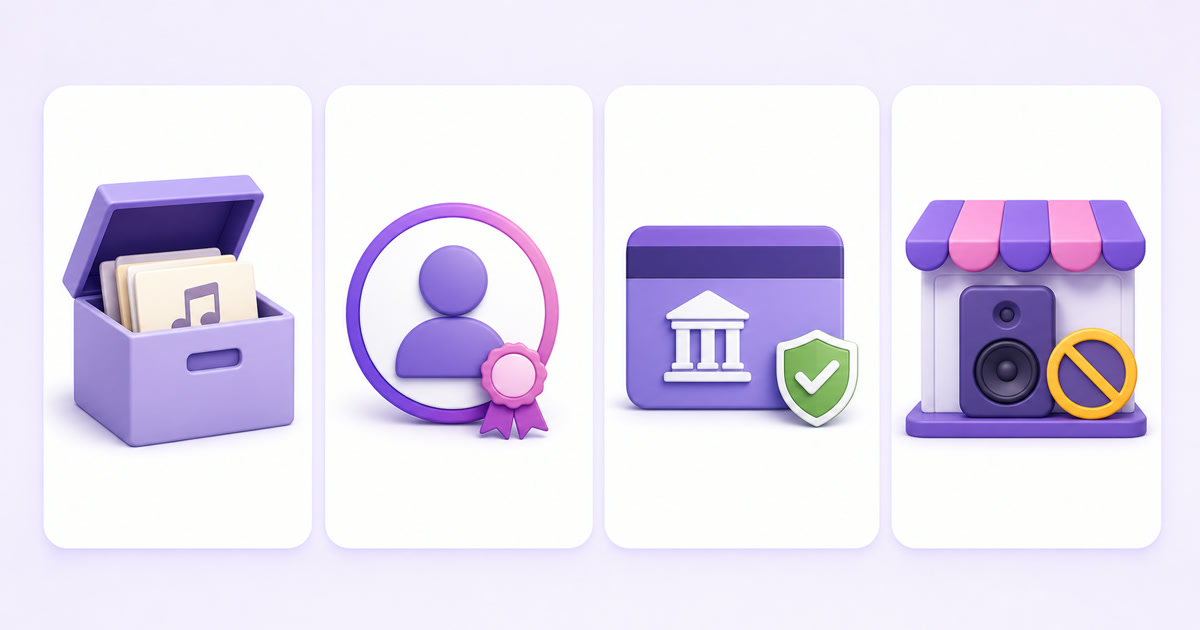
Four licence categories that are not interchangeable
Public domain
A public-domain composition does not automatically make every recording of it public domain. Copyright in the underlying song and copyright in a particular performance are separate works, as the U.S. Copyright Office explains. A traditional bhajan, hymn, or classical composition may be old enough to use, while a modern singer's recording and arrangement remain protected.
Creative Commons
Read the letters, not just the CC badge. CC0 is a public-domain dedication; CC BY permits commercial use but requires proper credit, a licence link, and a note about changes. Treat any licence containing NC as unavailable for a monetised channel unless the rights holder gives separate written permission: Creative Commons defines NC around uses not primarily intended for commercial advantage or payment.
Subscription royalty-free libraries
“Royalty-free” usually means the fee structure does not require a royalty for each play. It does not mean every use is permitted. A stock-music sync licence may cover background music in an original video but prohibit a radio-style stream where the tracks are the main attraction. As of July 2026, both Epidemic Sound and Artlist explicitly disallow standalone listening or playlist-style uses under their standard licences.
Background-music services for shops
A service that clears music for a café, gym, or retail floor solves a public-performance problem for that venue. That is not automatically an internet broadcast, video-synchronisation, reproduction, or monetisation licence. Unless the contract explicitly names livestreaming and your intended platforms, do not pipe an in-store account into YouTube or Facebook.
| Licence category | Safe for a monetised 24/7 loop? | Evidence to keep |
|---|---|---|
| Public domain | Only when both composition and recording are cleared in your territory | Source page, status research, recording provenance |
| CC0 or CC BY | Potentially; follow the exact licence and attribution terms | Licence snapshot, creator page, attribution text |
| Subscription royalty-free | Only if music-first livestreaming is expressly covered | Plan terms, invoice, track licence, channel clearance |
| In-store background music | Usually no; venue playback is a different use | A written broadcast grant, if the provider offers one |
Royalty-free does not mean claim-free
Content ID compares audio against reference files supplied by rights holders. The matcher does not inspect your invoice, read your description, or know that you bought a licence elsewhere. YouTube's own safe-music guidance says the system cannot see offline or third-party purchases.
That means a match can be technically correct even when your use is legally licensed. Your licence is what lets you resolve the match. Save the licence PDF, receipt, licence or order ID, exact track URL, download date, and the terms that applied on that date. A bookmark alone is weak evidence because pages and plans change.
Do this before the track enters your master mix. If the only proof is an old browser tab or a sentence in a random uploader's description, the track is not production-ready.
The whitelisting step almost everyone skips
YouTube tells creators using licensed third-party content to ask the owner to add their channel to the Content ID allowlist. Without that step, a licensed live stream can still be interrupted. “Whitelisting,” “allowlisting,” “safelisting,” and “clearlisting” are different names for the same operational idea: connect your channel or video to the licence before publishing.
As of July 2026, Epidemic Sound's safelisting and Artlist's Clearlist both require the relevant channel or content to be registered through the subscriber's account. That helps prevent automated claims, but it does not expand the licence. Their standalone-listening restrictions still make a music-first 24/7 radio loop unsuitable under the standard terms.
The same risk appears with your own releases. If a distributor enrolled your catalogue in Content ID, configure its channel allowlist or exclusions before you launch your 24/7 radio of your own tracks. Owning the track does not stop your distributor's reference file from matching it.
Sources worth evaluating, with the limits attached
YouTube Audio Library: This is the strongest platform-native starting point for copyright free music for live streaming on YouTube. As of July 2026, YouTube says Audio Library tracks can be used in monetised videos and will not be claimed by a rights holder through Content ID. Some tracks require the supplied attribution, so copy it exactly. The help page describes use in videos rather than promising every off-platform or music-only business model, so verify the current licence for your exact live-loop format before building a permanent radio around it.
Direct CC0 or CC BY releases: These can work when the person offering the licence actually controls both the composition and recording. Start at the original artist or label page, not a repost. Keep a dated copy of the licence and the precise attribution. For CC BY, credit the creator, link the licence, and say whether you edited the track.
Musopen and public-domain archives: Musopen is useful for research, but its own FAQ says it cannot guarantee that user-uploaded music is public domain. Check the composition and the specific recording separately, then account for the law where your stream is available. “Old” and “free to download” are not copyright statuses.
Subscription libraries: Epidemic Sound and Artlist are reasonable candidates for background music inside an original production, provided your plan covers the platform and you complete safelisting or Clearlisting. They are not candidates for a passive listening channel under the standard terms cited above. Other libraries must be checked for the same standalone-audio, compilation, livestreaming, monetisation, territory, and subscription-expiry clauses.
YouTube free-music channels: A channel is a publisher, not automatically the licensor. Its description may change, the uploader may lack rights, or an attribution promise may omit commercial and broadcast permissions. Use one only when it links to a verifiable licence from the actual rights holder and that licence covers your use.
The safest core for a 24/7 channel
The lowest-friction catalogue is music you recorded yourself or commissioned under a written agreement. The agreement should identify the composition and master recording, confirm who owns each, grant worldwide livestreaming and monetisation rights for the required term, and state who may register the work in Content ID. If a composer retains Content ID control, require your channel to be allowlisted.
Combine that core with a small set of tracks whose licences expressly permit music-first continuous broadcasting. Ten fully documented tracks are operationally safer than 200 uncertain downloads, because every song in an always-on mix may play thousands of times over its lifetime.
Test the catalogue on an unlisted event before committing it to your 24/7 lofi radio workflow. A clean test is useful evidence, though it never replaces the licence.
Build a cleared-music ledger
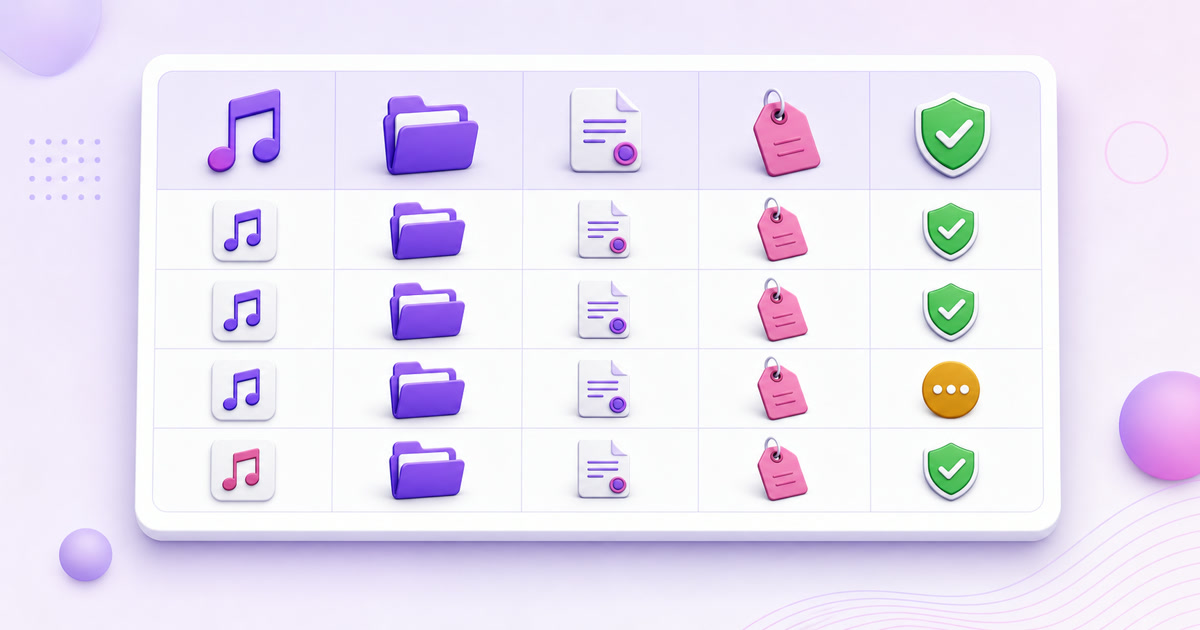
Use one row per track, not one row per album or library. The ledger should point to the proof file on storage you control, not just an external webpage. Add a review date when the licence is subscription-based or can change with your plan.
| Track | Source | Licence type | Licence ID or receipt | Whitelisted? |
|---|---|---|---|---|
| [Exact track and artist] | [Original URL or commission] | [CC BY 4.0, buyout, library plan] | [Document path and ID] | [Yes / No / Not applicable] |
| [Exact track and artist] | [Original URL or commission] | [Rights granted] | [Document path and date] | [Channel and confirmation date] |
For attribution licences, keep a ready-to-paste credit block beside the row. For a commissioned track, attach the signed agreement and payment receipt. For a subscription track, record the plan name, publication date, channel-clearance date, and a snapshot of the terms.
If you get claimed anyway
First, read the notice rather than guessing. A Content ID policy can monetise, block, or track matched content, sometimes only in certain regions. An active live stream may instead show a copyright warning or be interrupted. A claim is not automatically a strike; this claim-versus-strike guide explains the operational difference.
- Identify the exact track and claimant. Match the timestamp and asset name to your ledger.
- Confirm that your licence covers this use. Check livestreaming, music-first use, monetisation, channel, territory, and publication date.
- Fix clearance first. If the provider offers allowlisting, register the correct channel or ask the rights owner to do it.
- Dispute only with valid rights. Submit the licence ID, receipt, track details, and concise explanation. YouTube warns that an invalid dispute can escalate if the claimant requests removal.
- Replace an uncovered track immediately. Edit the source mix and restart with the cleared version instead of waiting through more cycles.
If the notice is a takedown or strike, follow the more serious response path in the guide to copyright strikes on 24/7 loops. Do not counter a removal request unless you genuinely have the rights and understand the legal declaration involved.
StreamNeo can keep a cleared loop running, but no streaming tool changes your rights position. Start free — 24-hour trial, no card.
More from the journal: Stream Key Rotation on a 24/7 Channel: When It Breaks You and How to Plan It · Your 24/7 Stream Died Overnight: The 3AM Failure Checklist · What a 24/7 Stream Is Worth to a Small Business Beyond Ad Revenue
FAQ
Is royalty-free music safe for a 24/7 stream?
It can be legally usable if the licence expressly covers livestreaming, monetisation, your platform, and a music-first continuous loop. Content ID may still match licensed audio, so keep the licence ID and complete any channel allowlisting. Never assume a generic stock-music or “royalty-free” label grants broadcast rights.
Can I use Creative Commons music on a monetised channel?
CC0 and CC BY material can permit commercial use, provided the uploader controls the relevant rights and you follow the terms. CC BY still requires correct attribution. Treat any NC-licensed track as unavailable for a monetised channel unless the rights holder gives you separate written permission for that exact use.
What happens if one track in my loop gets claimed?
The risky audio returns on every cycle, so the match opportunity keeps recurring. Check the claimant and policy, then use your ledger to prove the licence and correct any missing allowlisting. If your licence does not cover the stream, remove the track from the programme immediately rather than letting it repeat.