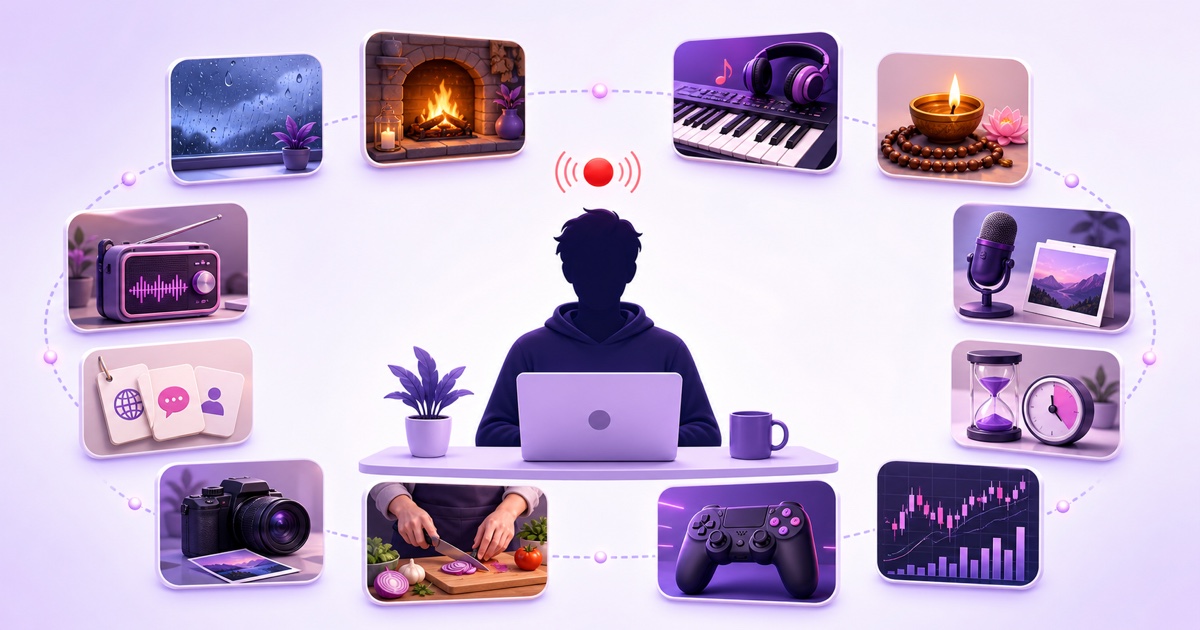
Most lists of faceless YouTube channel ideas tell you what to publish, but not whether the idea can survive a continuous stream, a copyright check, or a monetisation review. Those three tests matter more than whether you ever appear on camera.
The strongest faceless 24/7 stream is not anonymous filler. It is recognisably yours: material you recorded, performed, explained, designed, or deliberately programmed. Here is how to choose an idea that is practical to run and defensible when a reviewer looks beyond the thumbnail.
Why the loop is the most faceless format there is
A loop removes the parts of publishing that usually demand a visible host. You do not need a camera-facing performance, a daily recording slot, or even a voice. One well-made 60–120 minute render can become the reusable base of a long-running live schedule.
That convenience has a sharp edge. Faceless content is easy to start and equally easy to make worthless. A downloaded clip repeated under generic music may technically play all day, yet give a viewer no reason to stay and a reviewer no evidence of creative work.
YouTube's current channel monetisation policy calls mass-produced or repetitive work inauthentic content. Reviewers may examine the channel theme, top and newest videos, watch-time leaders, metadata, and About section. A live badge does not turn a weak template into an original programme.
Rights and copyright decide whether an idea is viable
Your safest inputs are footage, audio, photographs, graphics, performances, and code you made yourself. YouTube's copyright guidance says creators should own the necessary rights or have permission or a valid exception. Live streams are also scanned for third-party matches, so a questionable asset can interrupt the stream instead of merely affecting its archive.
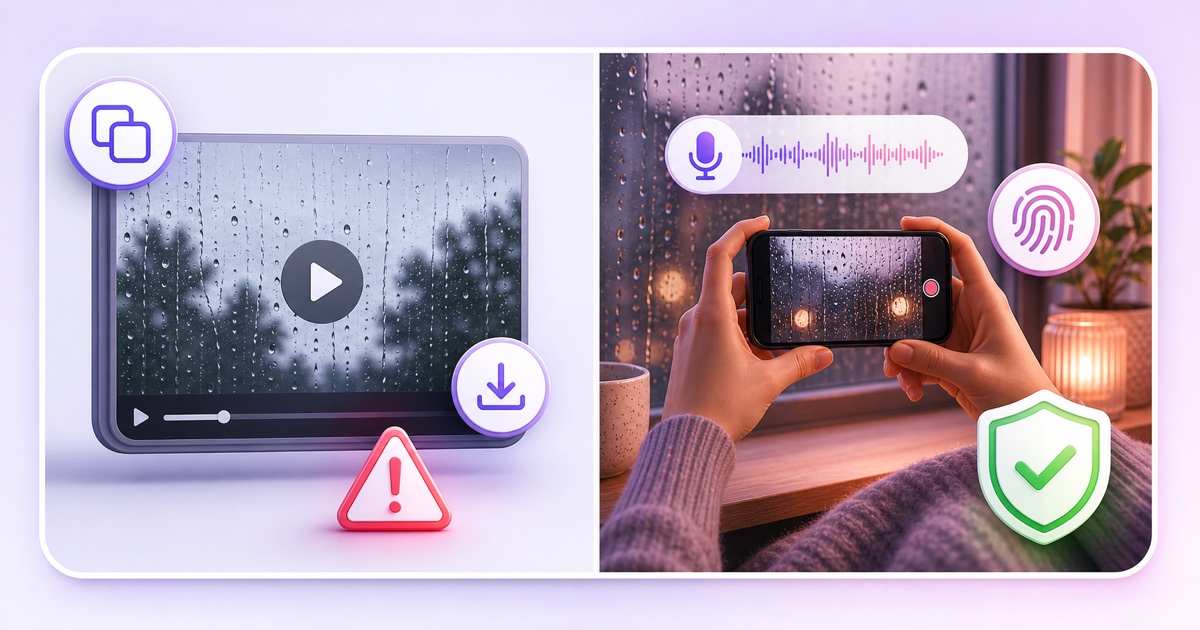
A stock subscription is not a blanket permission slip. Read the exact licence that applied when you downloaded an asset. For example, Envato's licence FAQ uses a stock train clip posted with only sound effects and a filter as an example of insufficient skill and effort because the clip remains the main value. A purchased rain clip used as the entire attraction can create the same problem.
AI-generated material needs the same discipline. Commercial-use terms can differ by generator, plan, asset type, and date. Save a copy of the terms and creation record, confirm that your inputs were lawful, and do not assume tool permission guarantees YouTube monetisation. Scraped films, reels, TV clips, temple feeds, or other channels' videos fail the basic ownership test.
Before choosing any idea below, answer three questions:
- Can I prove where every visual and sound came from? Keep original files, project files, recordings, invoices, and licences.
- Does the licence cover a continuous, monetised YouTube broadcast? Check streaming, commercial use, territory, duration, and Content ID terms.
- Would the programme still have value without the borrowed asset? If the answer is no, you probably need more original work.
The twelve ideas, grouped by what you already own
Ideas built from things you can record
1. Recorded ambience. Capture rain from your balcony, a ceiling fan, local birds, or a fireplace you can safely film. Build a 60–120 minute sequence with clean audio and subtle scene changes. Wind noise, visible private details, and accidentally captured music are the main risks.
2. Owned-instrument music. Perform your own tanpura drones, guitar instrumentals, piano pieces, or original beats, then mix a two-to-four-hour set. Retain the session files and confirm the composition is yours or cleared. A cover recording does not automatically clear the underlying song.
3. Mantra or devotional recitation. Record your own recitation and pair it with your own diya, mandir-detail, or abstract visuals. Aim for at least an hour with chapters or purposeful variations. Ancient words may be free of copyright while a modern melody, translation, backing track, or another performer's recording is not.
4. Hands-only cooking or craft footage. Film dough shaping, chai preparation, rangoli, knitting, miniature painting, or repair work from above. A 60–90 minute themed reel can loop naturally. Avoid copied recipes presented verbatim, background radio, visible personal data, and third-party packaging as the visual focus.
5. A slideshow of your photography. Programme your street, wildlife, travel, product, or night-sky photographs into a paced 60-minute gallery. Add original captions, location context, or an audio note where useful. A silent automatic slideshow can look thin in an originality review even when every photograph is yours.
Ideas built from things you know or design
6. Narration over your own stills. Explain a topic using your diagrams, photographs, or illustrations without appearing on screen. Record several 10–15 minute chapters and assemble a 90-minute programme. The risk moves from camera anxiety to factual accuracy, script quality, and rights in any supporting image.
7. A study or Pomodoro timer. Design the timer, session transitions, break prompts, and background scene yourself. A 25/5 or 50/10 cycle can fill a two-hour render without padding. Generic timer templates and unlicensed lo-fi music are the predictable weak points.
8. Market or exam-result information cards. Turn properly sourced public data into original charts, explainers, timestamps, and update cards. A 60-minute render works only if you also have a reliable refresh routine. Verify the source's reuse terms, show when data was updated, and never present delayed figures as real-time financial advice.
9. Language drill loops. Build English–Hindi vocabulary, pronunciation, listening pauses, or exam practice from lessons you wrote. Combine themed modules into a 60–120 minute learning block. Use your own voice or a properly licensed voice tool, and check every translation with a competent speaker.
Ideas built from a library you control
10. Your own gameplay. Cut your recorded sessions into a two-hour route, challenge, build, or strategy programme with captions or commentary. Check the publisher's video and monetisation policy, especially for in-game music and cinematics. Unedited idle footage is easy to produce but hard to defend as valuable.
11. A curated tracklist radio. Programme music for which you hold clear streaming and monetisation rights, with deliberate sequencing, transitions, visual identity, and track information. Two to four hours reduces obvious repetition. Permission does not guarantee monetisation: YouTube lists collections of songs from different artists, even with permission, among reused-content examples that may not qualify.
For a deeper rights checklist, read music you can legally stream before buying a catalogue.
12. A re-broadcast of your own past uploads. Assemble your tutorials, podcasts, webinars, or explainers into a themed two-to-four-hour channel block. Use new transitions, chapters, and a clear schedule so it feels programmed rather than duplicated. The risk is repetition across your own channel and a confusing experience for subscribers.
Need a wider starting pool? Compare these with 24/7 live stream ideas that grow a channel.
Rank them by effort-to-defensibility
This is a practical ranking, not a policy verdict. “Rights exposure” assumes you created the stated core assets; it rises where publisher rules, compositions, licences, or external data remain involved. “Originality signal” asks how clearly a reviewer can see your contribution.
| Idea | Production effort | Rights exposure | Originality signal |
|---|---|---|---|
| Recorded ambience | Medium | Low | Strong |
| Owned-instrument music | High | Low–medium | Very strong |
| Own devotional recitation | High | Medium | Strong |
| Hands-only process | High | Low | Very strong |
| Own photography slideshow | Medium | Low | Medium |
| Narrated visual lessons | High | Low | Very strong |
| Designed study timer | Medium | Low | Strong |
| Public-data cards | High | Medium | Strong |
| Language drills | High | Low | Very strong |
| Own gameplay programme | High | Medium | Strong |
| Licensed tracklist radio | High | High | Weak–medium |
| Own upload re-broadcast | Medium | Low | Medium |
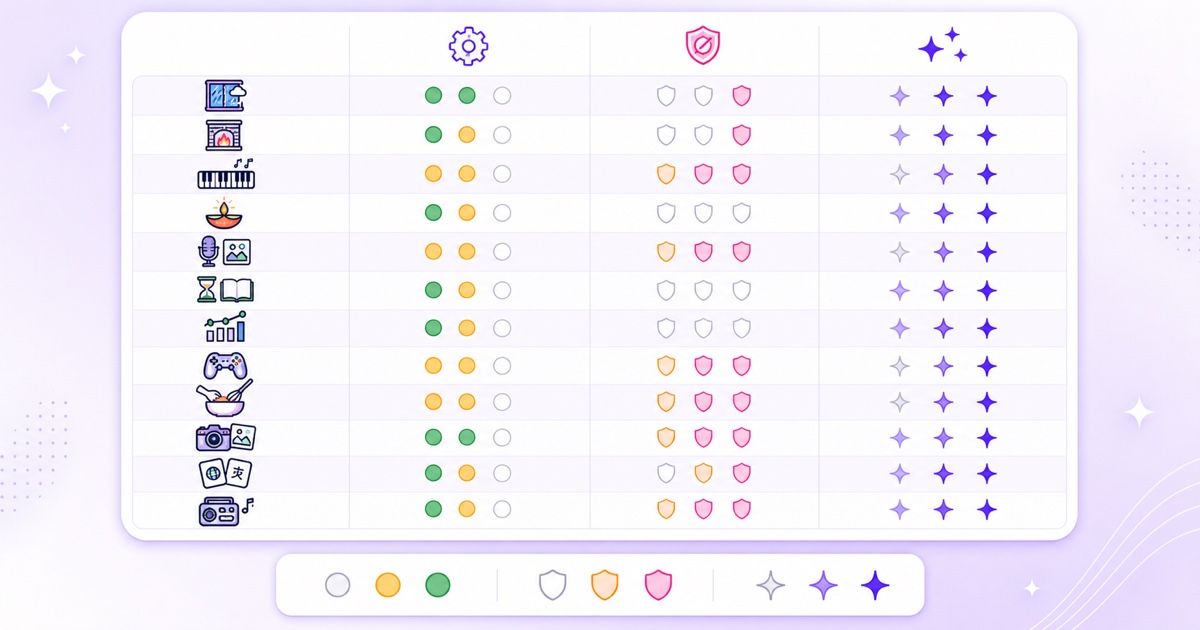
The pattern is blunt: the fastest concepts are usually the least defensible. Recording, performing, teaching, or designing takes longer because that labour is the value a generic automation channel lacks.
The added-value test
A faceless loop becomes easier to defend when you can point to visible decisions. At least one of these should be central, and two or three are better:
- You recorded it: the raw camera and audio files trace back to you.
- You performed it: the music, recitation, demonstration, or gameplay contains your choices.
- You narrated it: the structure and explanation teach something specific.
- You curated it with visible intent: sequencing, transitions, chapters, and context create a programme rather than a folder on shuffle.
- You built it: a timer, data card, lesson system, or graphic did not exist before your work.
A licence answers “may I use this?” It does not answer “did I add enough value for viewers and monetisation?”
Compare a purchased rain clip repeated for eight hours with rain you recorded, cleaned, mixed, chaptered, and paired with changing original scenes. Both are faceless; only the second carries obvious authorship. See the full breakdown of 24/7 loop monetisation rules.
Faceless does not mean voiceless
Your face is optional; a point of view is not. Use the description to explain how the programme was made, pin a message that sets expectations, answer live chat when you are available, and use community posts to ask what viewers want next. Those signals give an anonymous channel a recognisable personality.
A flawless stream with no conversation, context, or editorial taste can remain invisible. Treat the always-on video as the venue and your writing, moderation, updates, and programming as the host.
Pick one and scope it this week
Choose from assets you can create or already control, not from the niche that sounds largest. Sixty to 120 minutes of good material beats eight hours of filler. Use this one-week scope:
- List every asset and mark it owned, licensed, or uncertain.
- Remove uncertain material; do not plan to “fix rights later.”
- Produce one coherent 60–120 minute render with intentional chapters or cycles.
- Create a private test in YouTube Studio → Create → Go live → Stream, then review audio, loop joins, data accuracy, and phone playback.
- Publish one channel, learn from retention and chat, and consider a second only after the first has a repeatable production rhythm.
A phone, one finished render, and a stream key can be the whole technical stack, which is why this format works without a studio. StreamNeo can keep that pre-recorded programme live; your authorship is what makes it worth watching. If you later expand, use this multi-channel strategy to avoid cloning the same weak template.
Start free — 24-hour trial, no card. You can also check current pricing before choosing a plan.
FAQ
Can a faceless channel be monetised?
Yes, if the channel meets YouTube Partner Programme requirements and its content is original, authentic, and valuable. Showing your face is not the test. Mass-produced templates, minimally changed compilations, and repetitive low-value loops are the patterns most likely to fail review.
Do I need to buy stock footage?
No. Material you record yourself is usually the cleaner starting point. If you do use stock, read the specific licence and confirm that your finished stream adds substantial value instead of making the stock clip the product.
Which faceless idea is easiest to start?
The easiest viable idea is whatever you can record or build yourself this week. Owned rain audio, a hands-only demonstration, an original timer, or a short language lesson removes the biggest uncertainty: whether you have the right to keep streaming it.