A stock market live channel on YouTube does not need to display a terminal around the clock. A safer, more useful format is a recorded closing-analysis programme that stays available as a live loop until the next edition is ready.
The distinction matters. Your YouTube page may carry a live badge, but viewers must immediately understand that the programme and its prices were recorded after a specific market session. This playbook covers the daily operation without giving any market opinion. It is general information, not legal, compliance, financial, or investment advice.
The format that works: closing analysis, not fake live prices
For an equity-market edition, wait until the regular session has ended. The NSE publishes its equity market timings, including the normal 3:30 p.m. IST close. Record a 25–35 minute recap once the closing figures are settled, then loop that edition until you replace it on the next trading day.
Burn the recording date and time into the video. Use a title such as Nifty & Sensex closing analysis — 26 July 2026, not “live Nifty prices now.” The YouTube live badge describes the delivery method; it does not make yesterday’s prices current.
On Saturday and Sunday, switch to a clearly named weekly-review edition. On an exchange holiday, keep the last recap only if its date remains impossible to miss. This is the same credibility pattern that makes a daily recorded news digest useful: freshness is stated, not implied.
| Situation | Viewer-facing label | Operator action |
|---|---|---|
| Trading day | Recorded after market close · date · IST | Replace the prior edition that evening |
| Weekend | Weekly review · week ending date | Use a separate weekend programme |
| Market holiday | Market closed · last update date | Do not present the old close as today’s move |
| Material error | Correction notice | Remove, correct, re-export, and replace |
Compliance first: SEBI and the advice line
A disclaimer is useful disclosure, but it does not decide whether your activity is education, research, or advice. The substance of the programme, the securities discussed, whether you make recommendations, whether the material is personalised, and how you are paid all matter.
SEBI’s Research Analyst FAQs say that general market trends, broad-based indices, market-condition commentary, and statistical summaries are excluded from the definition of a research report. The same FAQs also make clear that a methodology such as technical analysis does not exempt security-specific research services. Public buy, sell, or hold recommendations can fall into the Research Analyst regime; personalised investment advice can engage the Investment Adviser regime.
There is an especially important current-data rule. SEBI’s May 2026 price-data circular, effective 1 July 2026, prescribes a 30-day lag for sharing and using market price data for educational purposes. Its amended education-versus-recommendation FAQ says a person engaged solely in education should not use price data from the preceding 30 days to name or code a security while indicating its future price, advice, or a recommendation. That makes “education only” a poor label to hide behind for a current, stock-specific prediction show.
Before launching, write down which lane the channel occupies and have an Indian securities-law or compliance professional review it. A sensible conservative operating policy is:
- Report broad market facts and explain concepts; do not issue stock-specific buy, sell, hold, target-price, stop-loss, or guaranteed-return calls unless you are properly registered and compliant.
- Never answer personalised portfolio questions in chat or direct messages as a casual add-on.
- Disclose holdings, conflicts, compensation, and sponsorship relationships where applicable.
- Archive every script, data source, video version, correction, and sponsor approval.
- If you are SEBI-regulated, follow the February 2026 social-media identification circular and display the required registered name and registration number.
Example disclosure: “Recorded after the market close on 26 July 2026, IST. This programme explains market information and does not provide personalised investment advice or a recommendation to transact in any security. Verify figures with the original source.” Adapt it to your actual activity and professional advice; copying this text does not create compliance.
Rights and copyright: charts, clips, and data
Your script, voice, original graphics, and original edit are yours. The underlying market feed, chart interface, business-news footage, music, and logos may not be. Keep a rights register with the asset, owner, licence, permitted use, attribution, and renewal date.
TradingView’s current published terms permit chart snapshots in publications and charts in video broadcasts when TradingView attribution remains clearly visible. Its Snapshot tool creates an attributed image. Preserve that attribution, do not crop it away, and recheck the terms before changing how you use the charts. Another chart or data vendor may impose different conditions.
Do not lift footage from a TV business channel, even if you add a voice-over or place it in a smaller frame. A subscription that lets you watch a channel does not grant rebroadcast rights. Use your own camera footage, licensed stock, and graphics you created or commissioned.
Real-time and delayed exchange data can also carry contractual restrictions separate from copyright. Confirm that your vendor plan permits recorded public video, looping, commercial use, and the number of destinations you intend to serve. Attribution is not a substitute for permission.
The daily production rhythm
The show becomes sustainable when the clock, template, and hand-off remain boringly consistent. For a normal trading day, use this run sheet:
- 3:30–3:45 p.m.: lock the session’s sources, confirm dates and time zone, and resolve discrepancies before writing.
- 3:45–4:15 p.m.: record the close, broad-index context, market breadth, notable public events, and one evergreen teaching segment. Do not improvise calls from chat.
- 4:15–4:35 p.m.: edit obvious mistakes, add the permanent timestamp and disclosure, then export a clean MP4. Use the H.264 and AAC export guide to avoid needless compatibility surprises.
- 4:35–4:45 p.m.: upload, replace the active playlist, and watch the public YouTube page with sound for at least one transition.
- After verification: retire yesterday’s edition from rotation, archive it locally, and update the title, description, and pinned message.
A practical 30-minute rundown is: a one-minute orientation, five minutes on broad indices and breadth, ten minutes explaining the session’s major drivers, eight minutes on one reusable market concept, three minutes on the next session’s public calendar, and a final recap. This structure remains informative without turning every episode into a tip sheet.
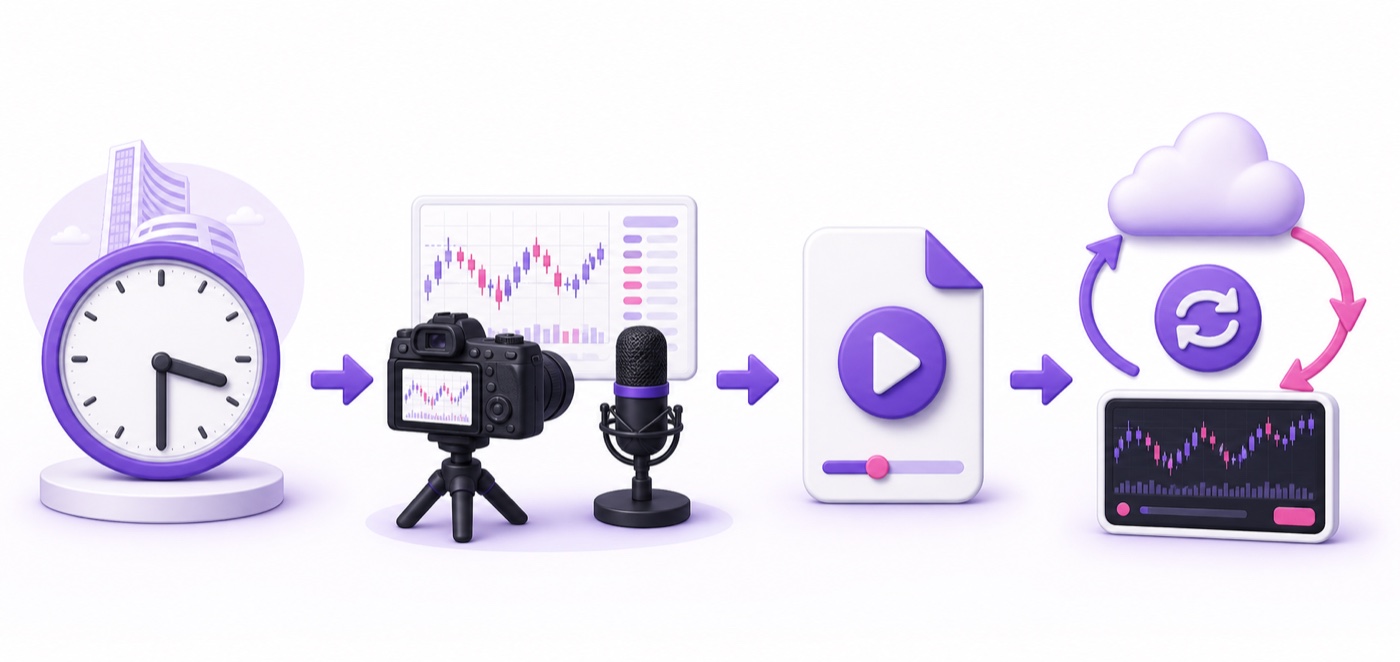
Swap the edition without rebuilding the channel
In StreamNeo, upload the new MP4, open the active slot in the dashboard, select the new video under the live destination, and choose Update Playlist. The same destination and stream key remain configured while the streaming push restarts with the new selection. A short viewer-side stall can still occur, so verify the public player instead of promising an invisible, frame-perfect switch.
This update can be handled from a phone after the file is ready. Keep the old edition selected until the replacement has uploaded successfully; remove it only after the new loop is stable. If you also publish a morning pre-open note, treat it as a separate, clearly timed edition and use the uploaded-video scheduling guide rather than quietly mixing it into yesterday’s close.
Stale-data honesty on screen
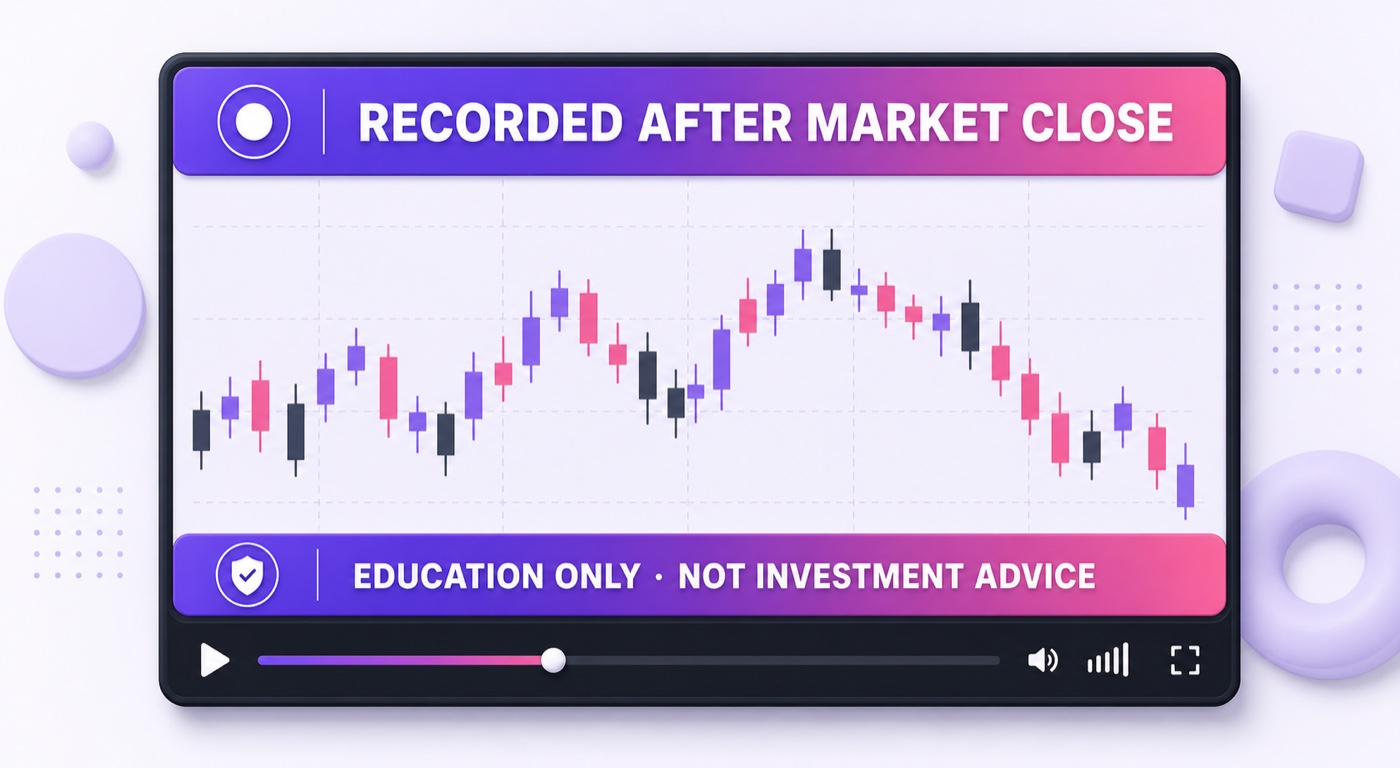
Put recency where viewers cannot miss it. A top banner should say Recorded 26 July 2026 after market close · IST. A persistent lower bar should describe the programme’s actual status and point viewers to the fuller disclosure in the description. Include the same date in the title and the first two description lines.
Do not use a tiny disclaimer to contradict a giant “LIVE PRICES” thumbnail. Do not animate an old quote as though it is moving now. If a chart uses delayed, end-of-day, or historical data, label the delay or observation period next to the chart itself.
Create a correction protocol before the first mistake. For a wrong label or number, stop the affected file from looping, correct and re-export it, replace the video, and add a timestamped correction to the description and pinned chat. Do not silently edit the description while the erroneous video continues playing.
Growth in a noisy niche
Searchable consistency is a stronger position than louder predictions. Use a fixed title pattern such as Nifty & Sensex closing analysis — 26 July 2026, then add one truthful topic after the date. A Hindi or Hinglish edition can use the language its intended audience actually searches, but keep the date, “closing analysis,” and recording status unambiguous.
Use one restrained thumbnail template: date, closing-analysis label, and one neutral visual. Avoid shocked faces, guaranteed-profit language, and screenshots of large gains. On weekends, publish an explainer or weekly review instead of stretching Friday’s recap through Sunday without context.
Set chat rules that protect the editorial line:
- No requests for buy/sell tips, targets, or portfolio reviews.
- No unsolicited Telegram, WhatsApp, or paid-group links.
- No claims of guaranteed returns or fabricated profit screenshots.
- Questions about concepts are welcome; personal recommendations are not.
Pin the rules and enforce them consistently. Review analytics after several editions for three operational signals: which topics hold attention, where viewers leave, and whether returning viewers find the newest edition. Improve pacing and clarity from those signals; do not manufacture a hotter opinion to chase one spike.
Monetization with care
Ads may be available if the channel and content meet YouTube’s programme and advertiser-friendly requirements, but a continuous loop is not automatically monetizable. Build original commentary, meaningful variation, and a clear viewer purpose. The deeper 24/7 loop monetization guide explains the platform side without promising approval.
Paid tip groups, referral funnels tied to aggressive recommendations, and disguised broker promotions create a much sharper compliance risk than ordinary channel ads. SEBI’s association rules also matter when a regulated intermediary wants to sponsor or collaborate with an unregistered creator. Have both sides’ compliance teams approve the relationship and the exact creative before publishing.
Label sponsorships prominently, keep editorial claims independent, and never let a sponsor buy a hidden recommendation. If the commercial model only works when viewers believe stale prices are live or generic education is a stock call, the model is broken.
A reliable market channel is an operating system for timely, attributed, clearly dated analysis—not a 24-hour prediction machine. Start free with a 24-hour trial, no card, and build the first closing-analysis loop around transparency from day one.
More from the journal: How to Build a 24/7 News Channel From Your Own Bulletins · Running a 24/7 Channel as a Side Business: A Realistic Weekly Time Budget · How to Reach 1,000 Subscribers With an Always-On YouTube Channel
FAQ
Do I need SEBI registration?
If you provide regulated investment advice or research services, registration requirements can apply. Broad market commentary and genuine education differ from stock-specific recommendations, but a disclaimer alone does not settle the classification. Read the current SEBI rules and obtain advice from a qualified Indian securities-law or compliance professional before publishing or charging.
When should the loop update?
Replace it the same evening after each market close. A workable target is to record after 3:30 p.m. IST, export and check the file, then publish the new edition by early evening. Use a separately labelled weekly-review programme for weekends and state exchange holidays plainly.
Can I show TradingView charts?
TradingView’s published terms allow chart snapshots and charts in video broadcasts when the required attribution remains visible. Use its Snapshot tool where suitable, preserve attribution, and check the latest terms and your plan before publishing. Other charting platforms and data vendors may have different licences.