
An always-on local news channel does not need to pretend that every minute is breaking news. A more sustainable format is a recorded daily digest: report the day's useful stories, label the recording clearly, loop it until the next edition, and replace it on a dependable schedule.
That distinction matters. Viewers should understand what was recorded, when it was recorded, and when they can expect an update. Done well, a 24/7 news channel on YouTube becomes a reliable community bulletin—not a stale video wearing a misleading “live” costume.
What this format is—and what it must never be
The product is a dated recorded digest. It might contain six district headlines, a civic-service update, a short field report, and tomorrow's weather from an attributed source. YouTube labels the watch page as live because a continuous feed is being sent, but your graphics and words must say that the editorial programme was recorded.
It must never present old footage as a current event or use “BREAKING” simply to manufacture urgency. YouTube's Misinformation Policies call old footage falsely presented as a current event “misattributed content” when it may create a serious risk of egregious harm. Not every stale label becomes a policy violation, but misleading viewers is still an ethical failure and a fast way to destroy trust.
Use “Live: daily district digest—recorded 26 July” rather than “Breaking now” for a bulletin that was recorded that morning.
Keep the same date in four places: burned into the video, in the ticker, near the start of the description, and in a pinned chat message. If an edition remains online after midnight, the visible recording date prevents a late-arriving viewer from confusing yesterday's facts with today's.
Rights and copyright: build from material you can actually stream
The safest source is your own reporting: your script, voice, interviews released for publication, and footage shot by you or your team. Licensed agency packages are usable only when the agreement explicitly covers YouTube livestreaming, the territories you serve, repeated use, and any archive. “Online use” alone is too vague to assume those rights.
Properly licensed stock can support an explainer, but it should illustrate rather than masquerade as footage of the reported event. Keep the licence, invoice, original download page, and contributor release in a rights folder for every edition. Use a music bed only if its licence covers livestreams and repeated broadcasts.
| Material | Before it enters the digest |
|---|---|
| Your field footage | Confirm location access, interview consent, and privacy-sensitive details |
| Guest or freelancer footage | Get written permission defining livestream, loop, archive, territory, and duration |
| Agency or stock media | Check the exact licence and save proof |
| TV-news clips | Do not lift them; use your narration, reporting, or licensed material instead |
| Music and graphics | Confirm commercial livestream and repeated-use rights |
YouTube says live streams are scanned for third-party copyrighted content. A detected match can bring a warning, a temporary interruption, or termination; archived streams can receive Content ID claims afterward. Even licensed material may need the rights owner to allowlist your channel. That is why copying a television bulletin is not a shortcut—it puts the whole live operation at risk. See the fuller guide to copyright strikes on 24/7 loops before building your source library.
The honest ticker format
A ticker should answer freshness questions before it decorates the screen. Put a permanent badge such as “Daily digest • Recorded 26 July” in a safe corner. Add “Next update • 8:00 a.m. IST” to the lower third, then identify the edition in the description as “Episode 042”.
Do not scroll undated headlines for hours. A viewer joining midway needs enough context to know whether a statement is from today, an earlier interview, or a weekly explainer. Prefix reusable segments with labels such as “Explainer—recorded 21 July” and show the source and publication date for public notices.
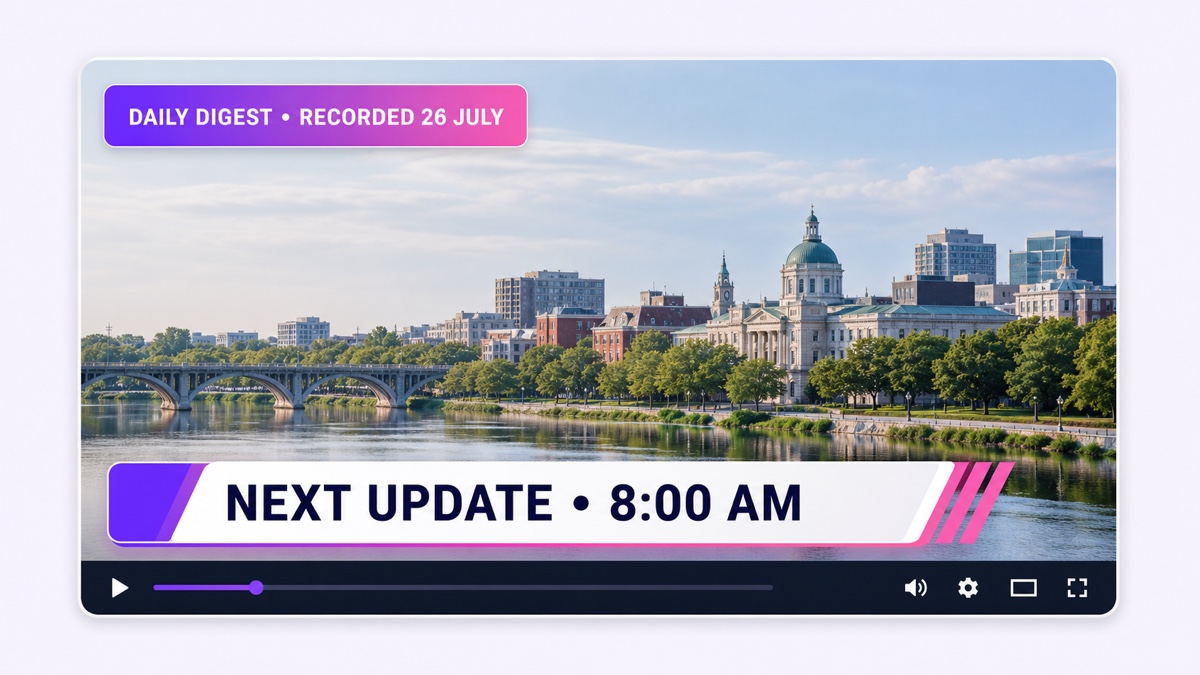
Speak the date near the start as well. Burned-in graphics can fail during an export, while an audible line—“This is the 26 July morning digest, recorded at 7:30 a.m.”—survives resizing, clipping, and casual reposts. Redundancy is useful when it protects meaning.
The daily production loop
Design the operation so one person can repeat it without newsroom-scale machinery. A practical morning bulletin can run 20–30 minutes. Longer is not automatically better; accuracy, clear attribution, and a predictable delivery time matter more than filling an hour.
- Gather and verify. Use primary documents, named sources, and direct calls. Keep unconfirmed social posts out of the script.
- Record. Read the date and edition number aloud. Add corrections from the previous programme before new headlines.
- Export. Produce a dependable MP4; the 24/7 streaming format guide explains H.264 and AAC settings.
- Upload and update. Add the new file to your streaming dashboard, select it for the active destination, and update the playlist.
- Retire yesterday. Remove the previous edition from rotation, but retain the source package and correction log according to your archive policy.
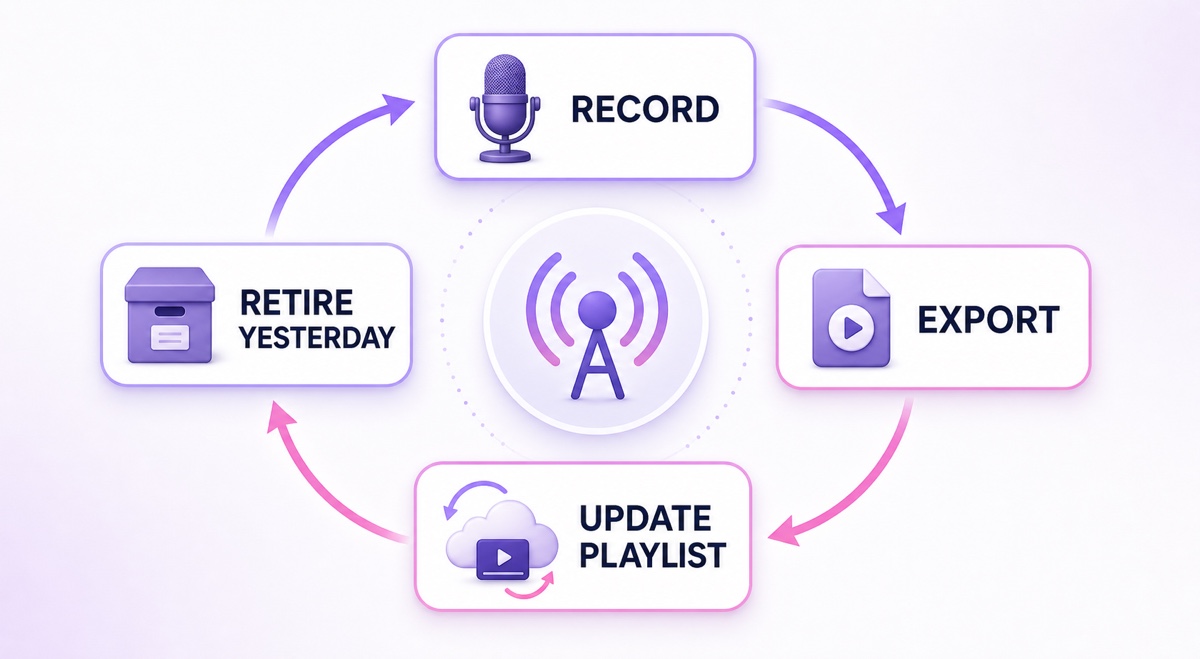
In StreamNeo, open the active slot, choose the new video for the YouTube destination, then tap Update Playlist. The service restarts the push on the same destination key, so the existing watch page remains the programme's home. Describe the viewer experience honestly: there can be a short transition while the new push starts; it is not a promise of literally zero dropped frames. Once the new file is uploaded, this change can be handled from a phone browser in roughly a couple of minutes.
If a bulletin should begin at a fixed public time instead of immediately, plan that publishing window with the uploaded-video scheduling guide. Whatever cadence you choose, rehearse one complete swap on an unlisted stream before launch.
Fill 24 hours without pretending every segment is new
A 25-minute bulletin will repeat frequently. That is acceptable when it is labelled, but a small evergreen library can make the programme more useful. Add a weekly interview, a “how the ward budget works” explainer, public-transport guidance, school-admission dates, or a civic helpline capsule.
Label every reusable block by type and recording date. A weekly explainer should not sit beneath a ticker that says “just in”. If a story changes materially, pull the old block rather than hoping the next edition will correct the impression.
- Daily: verified headlines, service changes, public notices, and a correction segment.
- Weekly: interviews, accountability explainers, local history, and issue summaries.
- Seasonal: monsoon preparedness, exam schedules, festival traffic, and heat guidance—with current official sources.
Maintain a simple rundown sheet with segment name, owner, recording date, expiry trigger, source links, and rights status. This turns “always on” from an improvisation into a controlled editorial system.
The regional-language opportunity
National headlines are crowded; district-level usefulness is not. A creator who reports panchayat notices, road closures, bus changes, local sports, and municipal decisions in Marathi, Tamil, Bengali, Bhojpuri, or another community language can serve questions larger outlets overlook. That gap is qualitative, not a guarantee of views.
Translate facts, not just captions. Explain official terms in the words people actually use, show the original document on screen, and link it in the description. For mixed-language audiences, a Hindi or English summary after the regional bulletin can widen access without flattening the main voice.
Your moat is not the ticker animation. It is being reachable, correcting errors, knowing which neighbourhood names are easily confused, and returning at the promised time. A basic phone-shot field report with sound verification is more valuable than polished borrowed footage.
Monetization and standards
News can earn ad revenue, but eligibility is not automatic. YouTube's advertiser-friendly content guidelines apply to live streams, titles, thumbnails, descriptions, and tags. Graphic violence, controversial issues, and sensitive events are assessed with context; responsible news reporting can be eligible, while exploitative treatment of tragedy may not be. Do not turn a disaster keyword into clickbait.
Publish a corrections policy before you need one. State how viewers can report an error, name the correction on air, update the description, and pin a chat message with the corrected fact. Preserve the original wording in an internal log so the team can see what went wrong. Quietly replacing an edition without acknowledging a material mistake is not a correction policy.
YouTube also says its systems look for expertise, authoritativeness, and trustworthiness, and that credible areas such as news receive extra attention to authoritative sources. A livestream badge alone does not make a small channel an authoritative news source. Transparent sourcing, accurate labels, original reporting, and a visible record of corrections are the unglamorous signals you can build.
If your digest covers markets, avoid drifting from reporting into careless tips; use the dedicated share-bazaar channel playbook for that format's additional guardrails.
Ready to make tomorrow's edition easier to operate? Start free — 24-hour trial, no card. Review the current options on the StreamNeo pricing page.
FAQ
Can I loop TV news clips?
Not unless you have explicit rights for repeated YouTube livestreaming and any resulting archive. For ordinary clip-lifting, the answer is no: live copyright scanning can interrupt or terminate the feed, and an archived stream can receive claims. Report the story in your own words and use footage you own or properly license.
How do I update the loop daily?
Record the new bulletin, export and upload it, select it in the active stream's playlist, update the playlist, then retire yesterday's edition. Keep the same visible recording date across the video, ticker, description, and pinned chat. Test the entire change once on an unlisted destination.
Will YouTube treat me as a news channel?
There is no switch that grants authority because a stream looks like television. YouTube says quality systems consider expertise, authority, trustworthiness, and whether content delivers on its promise. Build that foundation with original reporting, clear sourcing, honest freshness labels, and public corrections.