A meditation live stream can be useful without pretending to be a digital ashram that never sleeps. Its real value is simpler: someone arriving before work, during a difficult afternoon, or at 2 a.m. finds a calm, well-made session already in progress.
The strongest channels do not fill every second with generic music. They build a recognisable programme from original guided practice, properly cleared talks, intentional silence and a modest community ritual. Here is a practical way to create that channel without crossing the two lines creators often miss: speaker rights and medical claims.
Two formats, one channel
Guided meditation and spiritual talks serve different listening modes. A guided session asks the listener to follow a voice: settle the posture, notice the breath, scan the body or reflect on an intention. A talk or satsang asks for attention to an idea, story or teaching. Both can live in one stream, but random alternation feels abrupt.
Build in blocks. A useful starter programme might contain three 20–30 minute guided sessions, two 40–60 minute talks and short neutral transitions. Keep related pieces together: a breath practice can lead into a talk about attention; an evening body scan can lead into quiet ambience. Avoid cutting directly from a soft closing silence to an energetic lecture intro.
Give every unit a short orientation that still works for a mid-join listener. “You are joining a 25-minute breathing practice; sit comfortably and stop if you feel unwell” is better than a two-minute channel welcome. For talks, name the speaker and recording context near the beginning and in the on-screen caption. This makes a continuous loop understandable even when nobody starts at minute zero.
A simple first programme
- Arrival: 10 minutes of quiet settling or soft, licensed ambience.
- Guided block: two complementary 20–40 minute practices.
- Talk block: one clearly titled discourse followed by a short reflection pause.
- Repeat with a different energy: active breath work earlier, gentler material later.
If your library is mainly chants or ritual recordings, use the more specific aarti and mantra streaming guide; permission, music and performance rights can work differently there.
Rights & copyright + speaker permission
Your script, voice and recording are usually the cleanest foundation because you control each layer. A discourse delivered by a guru, visiting teacher or retreat guest is different. Being present with a camera, hosting the event or possessing the file does not automatically settle who can rebroadcast the speech forever.
Get permission from the person or organisation that actually controls the recording and the underlying talk. YouTube’s own copyright guidance says rights holders decide who may use and distribute their work, and YouTube cannot grant those rights for you. Read its copyright overview before treating an old upload as reusable.
A casual WhatsApp “yes, you can share it” is better than silence, but a clear written licence is far safer. It should identify the recording and cover:
- continuous and repeated livestreaming, not only a one-time upload;
- the approved platforms, territories and permission period;
- whether the channel may monetise the broadcast;
- editing, excerpts, playlist placement and promotional clips;
- translations, subtitles and dubbed versions;
- any music, slides, quotations or guest voices inside the recording;
- who can request removal and how quickly you will act.
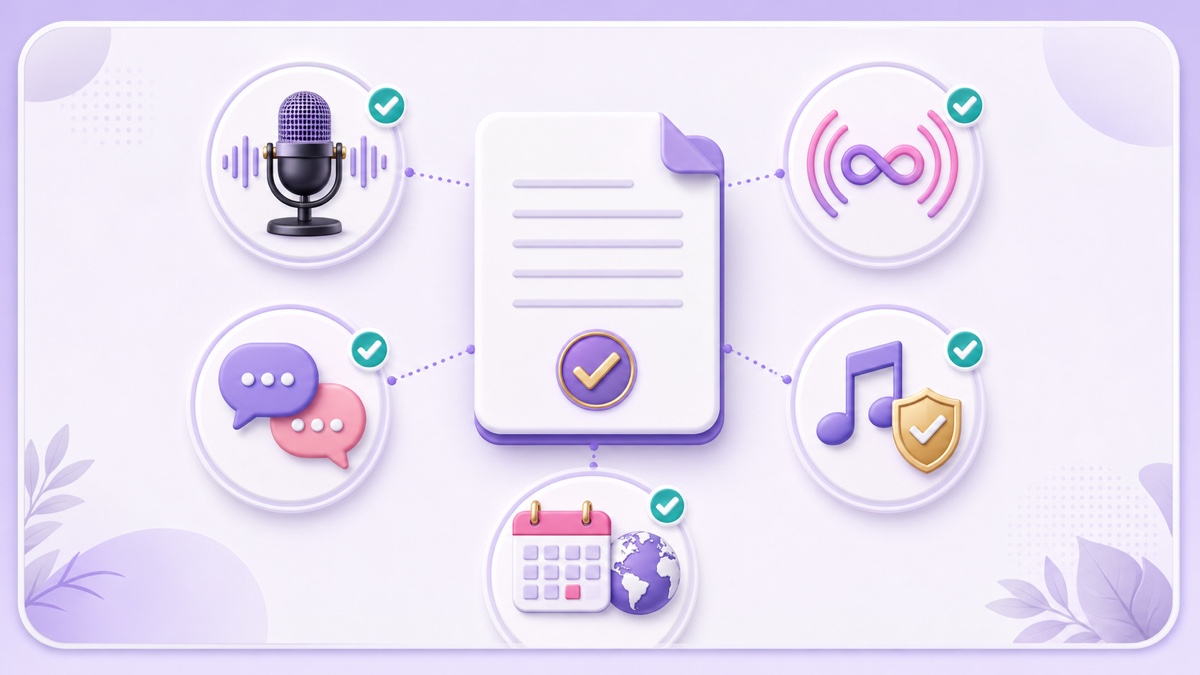
Organisational archives need special care. The venue may own the camera recording while the speaker retains rights in the words, or an event agreement may assign both to another entity. Resolve that chain before upload. Keep the signed document, relevant emails, original project file and music licences together in a rights folder for each programme.
Translation is not merely a technical caption setting. Copyright owners commonly hold the right to authorise translations and adaptations; the World Intellectual Property Organization’s copyright FAQ lists translation among those economic rights. Ask for that scope explicitly, and let the speaker approve sensitive terminology before publishing subtitles.
Background music needs its own clearance for livestream and repeat use. “Royalty-free” describes a payment model, not universal permission. Check the actual licence, keep the receipt, and use the rights workflow in the 24/7 lofi radio guide when music is a substantial part of the channel.
The health-claims line
Meditation may be discussed as a wellbeing practice. Do not turn that into a diagnosis or guaranteed treatment. “This breathing practice cures anxiety,” “stop medication after this session,” and “meditation treats depression better than therapy” are not responsible channel promises.
As of July 2026, YouTube’s medical misinformation policy is not a blanket ban on health discussion. It prohibits medical misinformation that creates a serious risk of harm by contradicting local health-authority guidance about specific conditions or treatments, and it applies to live streams, descriptions and comments as well as videos. That is narrower than saying every mention of anxiety breaks policy, but it is still a clear reason not to improvise treatment advice.
Use language proportionate to what you can support:
- Say “a practice many people find calming”, not “a cure for panic attacks”.
- Say “may support a wind-down routine”, not “guarantees eight hours of sleep”.
- Say “educational guidance, not medical care”, then make the content itself match that disclaimer.
- Encourage someone with symptoms or distress to seek qualified professional help; never tell them to replace prescribed care.
A disclaimer cannot rescue a reckless claim. Review the spoken audio, title, thumbnail, description, pinned message and automated chat prompts as one package. If a guest makes a medical claim during a long talk, edit it before the talk enters the loop rather than hoping context will fix it.
Record guided sessions that loop well
A calm room matters more than an expensive camera. Put the microphone 15–20 cm from the speaker, slightly off-axis to reduce breath pops, and record a 30-second room-tone sample before each session. Use the same microphone position and gain across the series so listeners do not reach for the volume control between tracks.
Make each guided unit 20–40 minutes. That is long enough to settle into a practice and short enough to arrange into different blocks. Start with a 10–15 second orientation, keep instructions specific, and close in a way that does not assume the whole audience will leave. “Remain here if you would like more quiet” flows into the next segment better than an abrupt sales message.
Silence is not missing content. It is part of the instruction. Leave deliberate pauses for three breaths, a body scan or reflection, but monitor the recording so “intentional quiet” does not contain air-conditioner clicks, chair noise or a phone vibration. Mark long pauses in your editing timeline; that makes it easier to distinguish craft from an accidental empty section.
Export consistent files: MP4 with H.264 video, AAC audio and a common frame rate, resolution and sample rate across every playlist item. Use a restrained visual—a teacher on camera, a slowly moving abstract background or accurate captions. Flashing particles and constant cuts fight the reason the listener arrived.
Program the day
Dayparts give a spiritual-talk channel rhythm without requiring new content every hour. A practical India-first sequence is an energising sit in the early IST morning, accessible breath work around lunch, longer talks in the evening, and low-stimulation guidance or licensed ambience overnight. Use your own audience analytics later; viewers in another region may reverse that pattern.
There are two honest ways to build it. First, order a fixed playlist as a miniature day and let it repeat. This creates variety, but it will not stay aligned to the clock forever unless the total duration is exactly 24 hours. Second, change the playlist at chosen boundaries. That keeps morning and evening blocks accurate but requires someone—or a scheduling workflow—to make the change.
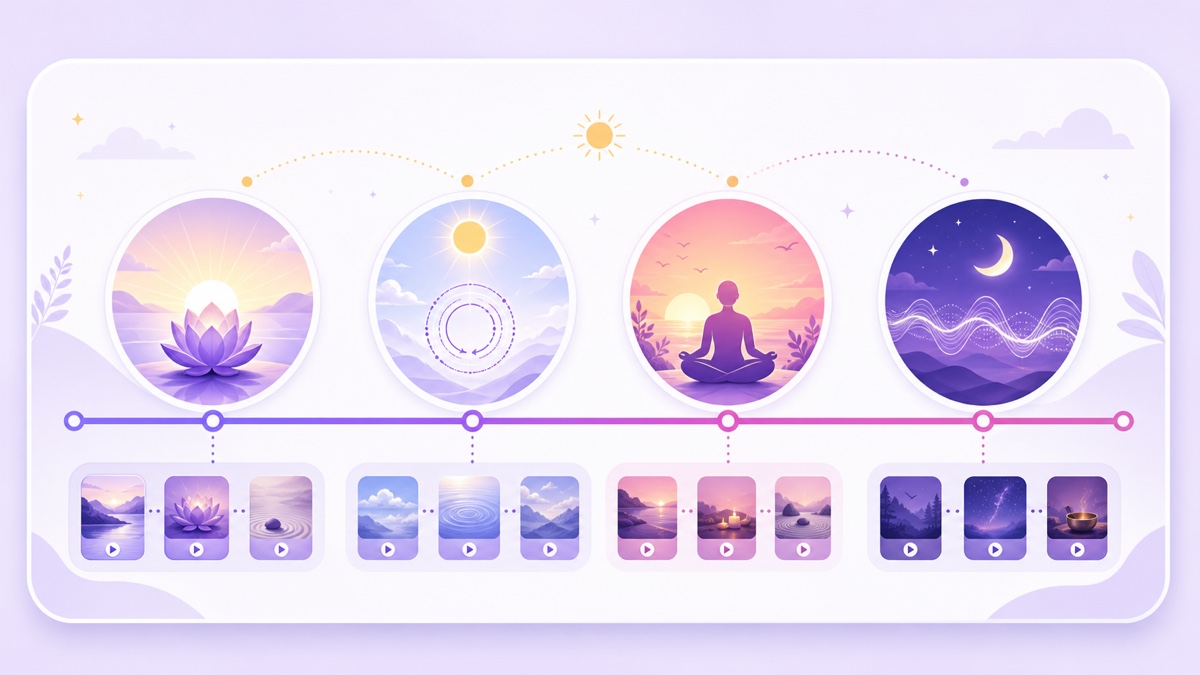
StreamNeo can keep the playlist broadcasting from the cloud, so a studio computer does not need to remain on. From a phone, you can update the active playlist when a daypart changes; the current product supports playlist updates during a stream, while exact clock-based changes should be planned through the workflow in the uploaded-video scheduling guide. Do not describe a repeating three-hour playlist as if it were truly synced to local time.
Begin with four blocks, not a complicated broadcast calendar. Name each file clearly, keep a master order sheet, and listen through every transition before going public. If a talk ends with applause, announcements or a retreat-specific date, add a neutral bridge before the next meditation.
Community without performance
Chat can feel like a quiet sangha rather than a scoreboard. Pin one low-pressure prompt such as “What intention are you practising with today?” or “If you joined midway, take one comfortable breath.” Invite answers, but never suggest that public participation proves commitment or spiritual progress.
Moderation matters because vulnerable health stories may appear in chat. Create blocked-word and link rules, appoint a moderator for predictable busy periods, and prepare a short response that directs urgent medical or mental-health concerns to appropriate local professional help. Do not let volunteers diagnose viewers.
Membership perks should deepen practice without dividing the public stream into “serious” and “less serious” listeners. Useful options include downloadable sessions you own, ad-free audio files, a monthly live sit, a reading circle or early access to a new programme. The always-on memberships guide explains how to keep these offers visible without interrupting the experience.
Launch honestly
Start with one carefully edited programme of roughly three hours. That can mean three guided sessions, two talks and quiet bridges. Loop it privately or as an unlisted test first, join at random points, listen on phone speakers and headphones, and check every transition. One coherent library teaches you more than ten rushed uploads.
- Confirm written rights for every voice, composition, image and translation.
- Review titles and spoken claims for medical promises.
- Test the programme for at least one full loop, including silent sections.
- In YouTube Studio, go to Create → Go live → Stream, set the title, description, visibility and stream key, then connect the cloud stream.
- Run a seven-day pilot and log drop-offs, chat questions, volume jumps and requests for specific session types.
Use feedback to replace the weakest unit, not to rebuild everything at once. The first sign of progress is not a giant concurrent-viewer number; it is a programme people can enter at any moment without confusion, rights anxiety or exaggerated promises.
Start free — 24-hour trial, no card, and test the complete programme before you commit it to an always-on channel.
More from the journal: FAST Channels Explained for Creators: Linear TV Without a Broadcaster · Navratri, Diwali and Ganesh Chaturthi: A Practical 24/7 Channel Playbook · Running a 24/7 Channel as a Side Business: A Realistic Weekly Time Budget
FAQ
Can I loop my teacher’s discourse?
Only after the rights holder gives clear written permission for repeated livestreaming. Confirm who owns both the talk and its recording, then cover platforms, monetisation, editing, translations, music and the permission period. Hosting the event or receiving the file is not enough by itself. Keep the agreement and supporting licences with the programme archive.
Can I claim health benefits?
You can describe a practice and use careful wellbeing language, but avoid diagnoses, guaranteed outcomes or claims that meditation replaces treatment. YouTube’s medical misinformation rule focuses on harmful claims that contradict health-authority guidance for specific conditions. “Many people find this calming” is appropriately modest; “this cures depression” is not. Review guest talks and metadata too.
Should the channel be guided or music-only?
Guided sessions give the channel a distinct teacher, method and reason to return. Music-only programming competes directly with a very crowded ambience category and still requires clean music rights. A strong starting mix is mostly original guided practice, selected cleared talks and short musical or quiet bridges, with consistent sound levels across every unit.