
A mantra channel has a useful advantage that most loop channels do not: repetition is already part of the listening experience. A devotee may want a Gayatri mantra during morning puja, an Om chanting stream while working, or a steady jaap late at night. The stream is not pretending that ten minutes of material is a two-hour performance; the return itself is the format.
That simplicity can still hide three difficult jobs. The loop must sound continuous, every audio and visual element must be cleared for use, and the channel must treat devotional attention with care. This playbook shows how to solve those jobs without turning the stream into a noisy growth trick.
The format: repetition is the product
Mantras are practised through deliberate repetition: a fixed count such as 108, a timed session, or a continuous akhand-style jaap. A 24/7 feed extends that familiar pattern across time zones. Someone who opens the stream at 5:30 a.m. in Jaipur and someone listening after work in Toronto can enter the same steady practice without waiting for an upload to begin.
Choose one promise before recording. A title such as Gayatri Mantra 108 Times promises a countable cycle. Non-stop Om Chanting promises continuity. A morning-and-evening aarti channel promises a daily rhythm. Those are different products, even when they use some of the same audio.
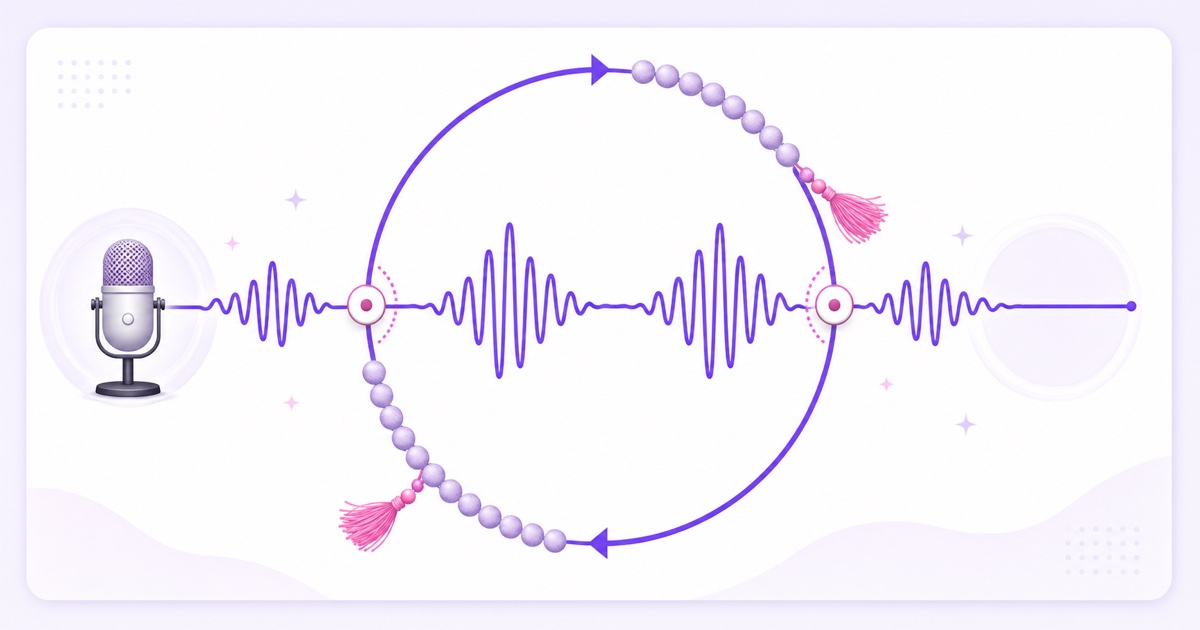
Do not confuse repetition with carelessness. A short clip with a loud seam every 40 seconds will feel mechanical. A coherent 10–30 minute performance, recorded at an even pace and joined invisibly, feels intentional. The longer source also gives natural variations in breath and tone, so regular listeners do not hear the same tiny phrase every few seconds.
Rights and copyright for chants
The words of genuinely ancient mantras are generally in the public domain because their copyright term expired long ago. That does not put every Gayatri mantra video, album, backing track, translation, or artwork into the public domain. Copyright can attach separately to the modern things built around the old text.
India's Copyright Act treats original literary and musical works and sound recordings as distinct classes of work. It also says that copyright in a sound recording does not erase the separate copyright in the work recorded. The practical result is simple: an ancient Sanskrit verse may be free to recite, while a famous singer's rendition, a label's instrumental bed, and a producer's master recording remain protected. See the Copyright Office of India's explanation of protected works and separate rights.
A modern translation or commentary can also contain original expression. The Copyright Office's literary-works manual specifically explains that copyright may subsist in a translation. Write your own plain-language explanation, use a translation whose licence permits the intended use, or obtain permission. Do not copy a recent book's translation merely because the underlying mantra is old.
The cleanest route is to record your own voice, instruments, room sound, and video. Keep the raw takes, project files, permission emails, and any music licences in a dated folder. YouTube says live streams are scanned for third-party material; a match can interrupt or terminate a broadcast, and even properly licensed material may need the rights holder to allowlist the channel. Its live-stream copyright guidance explains that risk. For claim and strike scenarios, use this 24/7 loop copyright guide.
Rights test: Can you show where every voice, instrument, image, translation, and video shot came from? If one element has no clear answer, replace or clear it before going live.
Record a loopable chant
A quiet room and consistent delivery matter more than an elaborate studio. Switch off fans and buzzing chargers if the room allows it, move the phone or microphone away from reflective walls, and keep the mouth-to-mic distance fixed. Record a short room-tone sample first, then monitor with headphones for hum, clipping, traffic noise, and harsh breath sounds.
- Set the pace. Use a silent visual cue or a very soft click in headphones if the count tends to drift. Do not record an audible metronome unless it belongs in the final experience.
- Capture one clean 10–30 minute take. Restart after a major cough or stumble instead of assuming heavy editing will hide it.
- Leave safe headroom. Avoid recording close to digital clipping. Loudness can be adjusted later; distorted peaks cannot be repaired cleanly.
- Edit distractions, not humanity. Remove obvious bumps and long accidental gaps, but preserve a natural breath and cadence.
- Test the join repeatedly. Listen on headphones, a phone speaker, and a small Bluetooth speaker before exporting.
The loop-point trick is to plan the final phrase before you press Record. Start and finish on the same phrase, pitch centre, room tone, and breathing position. In the editor, overlap a short matching ambience region and use a gentle crossfade. Never crossfade across two different syllables; that produces a blurred word. Duplicate the finished clip three times on the timeline and listen across both joins. If you notice the boundary while your eyes are closed, adjust it again.
Export a delivery file with predictable settings rather than sending an editor project to the streaming service. MP4 with H.264 video and AAC audio is the broadly practical combination; keep every item in a multi-video playlist on matching resolution, frame rate, and audio settings. The 24/7 streaming format guide covers those choices in detail.
Timed segments vs a pure loop
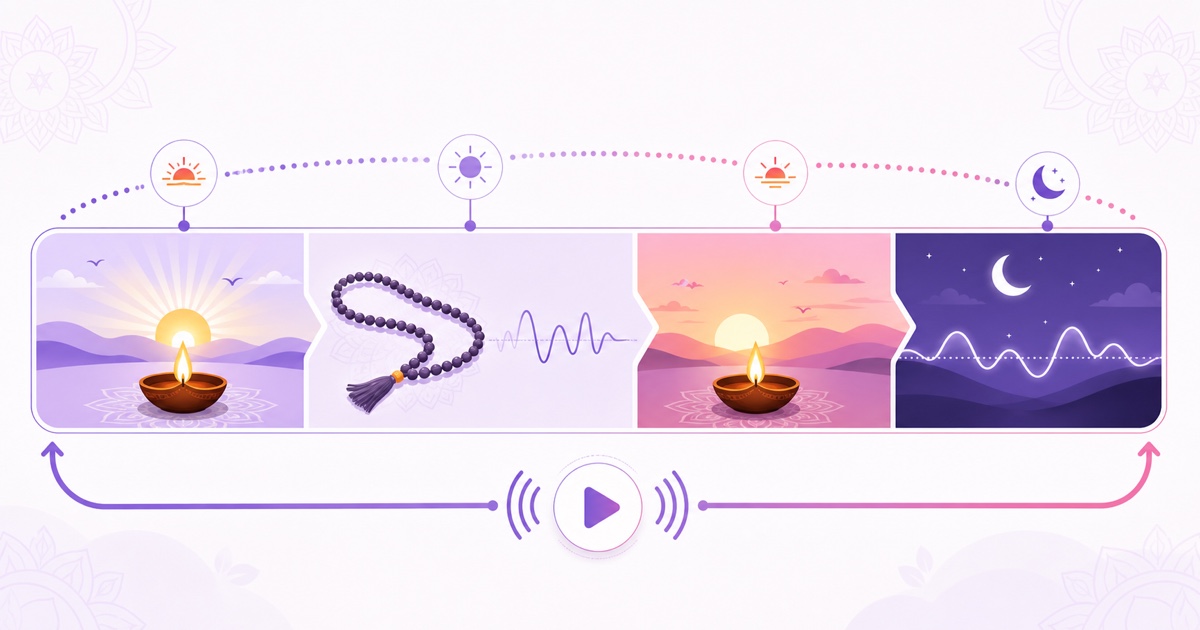
There are two useful architectures. A pure loop carries one jaap continuously. A structured day changes material at meaningful times: morning aarti, daytime mantra, evening aarti, then a gentler overnight segment. Neither is automatically better.
| Architecture | Best for | Operational benefit | Main risk |
|---|---|---|---|
| Pure continuous loop | Om chanting, single-mantra jaap, meditation | Simple library and one consistent promise | Frequent listeners may want more variety |
| Timed daily structure | Channels built around morning and evening aarti | Matches an existing devotional routine | More files, timing checks, and transition points |
For a pure loop, prepare one excellent master before adding more material. For a daily structure, create separate approved files and write the IST timetable first. Allow a few seconds of neutral room tone or a calm visual between blocks so a switch does not cut a mantra in half. Test the whole sequence as an unlisted stream before announcing a schedule.
StreamNeo keeps the operational pieces in one dashboard: upload the approved chant and aarti videos, open Streams, select a slot, add the YouTube stream key, choose the video or playlist, and start the cloud stream. For timed events, pair those assets with the scheduling workflow instead of waking someone up to run a laptop encoder. This guide to scheduling a live stream from an uploaded video explains the event-page and feed-start halves. Check the public watch page after every planned change; a timetable is not a substitute for verification.
Visuals that respect the content
The visual should support attention, not compete for it. A steady diya, a mala, a yantra you have permission to reproduce, or your own slow footage of a clean puja space can work. Gentle movement helps viewers understand that the feed is active, but rapid particles, flashing transitions, and jump cuts quickly become exhausting on a long session.
Shoot your own footage whenever possible. Lock a phone on a tripod, clean the lens, disable notification pop-ups, and record more time than the audio loop needs. If filming inside a temple, get written permission from the trust or management before recording the deity, rituals, priests, devotees, or music. The temple darshan streaming guide covers permissions and honest recorded-darshan labels.
A Devanagari line with a carefully checked transliteration can help someone chant along. Verify spelling with a knowledgeable reader, keep the line large enough for mobile screens, and use restrained transitions. If you display a modern translation, clear its rights or write your own explanation. Also avoid presenting a pre-recorded aarti as if it is happening at a real temple at that exact moment.
The ads question this niche must answer
A mid-roll can interrupt a mantra halfway through a phrase. That is not merely a retention issue; some creators and listeners see it as inconsistent with the purpose of the session. Other channels rely on ad income to fund recording, moderation, and streaming. The right choice depends on the channel's values, costs, and audience expectations.
YouTube allows eligible live streams to use automatic or manual mid-rolls. In YouTube Studio, the current path is Create → Go live → Stream or Manage → Edit → Monetization. YouTube also notes that ads are not guaranteed for every viewer. Review its official live-stream monetization controls, then choose deliberately.
- No mid-rolls: least disruptive to continuous practice, with less ad opportunity.
- Manual breaks: place an allowed break between complete aarti or jaap blocks, never mid-phrase.
- Automatic mid-rolls: lower operational effort, but the creator gives up precise control over the devotional moment in which an eligible viewer may see an ad.
State the channel's approach plainly if viewers ask. Do not promise an ad-free experience unless you control every relevant setting and understand that platform behaviour can change. For the wider eligibility and placement picture, read the live-stream ads guide.
Growth without gimmicks
Make the title describe the real listening experience. Useful patterns include Gayatri Mantra 108 Times, Om Chanting Live — Non-stop Jaap, or Morning Aarti and Mantra — Daily Devotional Stream. Put the language, count or duration, and whether the footage is recorded in the description. Avoid claims such as “instant miracles” or an invented live temple location.
Consistency is more valuable than constant renaming. Keep a stable watch-page promise, use a readable thumbnail, and publish the timetable in IST plus one or two audience-relevant time zones. Festival specials can add a distinct approved recording for Navratri, Maha Shivratri, or another relevant observance without turning the everyday channel into a keyword pile.
Invite participation that fits the space. A pinned message can ask devotees to share a sankalp without posting phone numbers, addresses, or sensitive personal details. Assign moderators, write a simple rule against spam and miracle-cure claims, and respond in the language your audience actually uses. If the channel mixes bhajans with chants, compare the programming choices in the 24/7 bhajan channel playbook.
A practical launch check
- Listen across three consecutive loop boundaries with the screen hidden.
- Confirm written rights or ownership for every audio, visual, and displayed translation.
- Run an unlisted test and inspect the public player from mobile data, not only the creator dashboard.
- Check morning and evening changes against IST and confirm that no mantra is cut in half.
- Decide the mid-roll policy before viewers make the decision for you through complaints.
- Keep a backup master and a rights folder separate from the streaming upload.
Once the recording, visuals, and permissions are ready, the final job is keeping that carefully made loop available without sacrificing a phone or computer to it. Review StreamNeo pricing, then Start free — 24-hour trial, no card.
More from the journal: Running a 24/7 Channel as a Side Business: A Realistic Weekly Time Budget · How to Build a Rolling Weather and Traffic Loop for a Local Audience · Monetising a Devotional 24/7 Channel Respectfully
FAQ
Are mantras copyright-free?
The text of a genuinely ancient mantra is generally in the public domain. A specific singer's recording, modern musical arrangement, video, artwork, translation, or commentary can still be copyrighted. Your safest base is your own recording plus visuals you created or clearly licensed.
Can a 10-minute chant run 24/7?
Yes. Repeating the source is the loop's job. Record a musically complete segment, make its beginning and ending compatible, crossfade only matching ambience, and test several consecutive joins before going live.
Should aarti streams run ads?
That is the creator's values call. Disabling mid-rolls protects continuity but gives up that ad opportunity; manual breaks can sit between complete segments; automatic mid-rolls require less management but provide less control over the interruption point.