A city radio-style channel sounds simple: collect some songs, record a few links, and leave the stream running. The difficult part is not the streaming software. It is building a station identity without borrowing music, news audio, or sponsor material you do not have permission to use.
The workable version is more interesting anyway. Think of an online radio station YouTube viewers can recognize as their city's voice: approved tracks from local artists, your own short talk segments, useful event notes, and a broadcast day refreshed on a dependable schedule. You do not need an FM studio. You do need clean rights, honest labels, and enough local personality to make the channel worth returning to.
What a YouTube “radio station” legally is
A YouTube city station is a live video stream delivered over the internet. It is not an FM or AM transmission using radio-frequency spectrum, so creating the YouTube stream itself does not require a spectrum broadcast licence. Calling the project “radio,” however, does not create any exception to copyright, music licensing, advertising rules, privacy, or the laws that apply where you operate.
That distinction prevents the biggest early mistake. YouTube provides the delivery platform; it does not give you permission to rebroadcast songs. A music subscription, a purchased download, a CD, or access to a track on another platform is permission to listen under that service's terms, not permission to place the recording inside your own continuous live channel.
Package the channel honestly. If the programme was recorded and assembled earlier, say “pre-recorded local music and city talk, streaming continuously” in the description. Do not imply that an RJ is currently in a studio, that an interview is happening now, or that the channel is an FM frequency. “LIVE” can truthfully describe the YouTube delivery while the description explains that the programme itself is pre-recorded.
The clean operating rule: every song, voice, interview, photo, sound effect, and sponsor asset in the loop should be yours or covered by permission that includes continuous online live use.
The music-rights reality
Bollywood hits and other commercial releases are not a realistic starter library. A song can involve rights in the composition and lyrics as well as rights in the particular sound recording. An artist you know may perform on a track without controlling every one of those rights. Content ID finding or not finding the song does not change whether you have permission.
The practical route is a smaller, deliberately cleared catalogue. Approach local singers, bands, beatmakers, labels, and independent producers directly. Explain the channel, show how often the broadcast will repeat, say whether you plan to monetise it, and request written permission. Local exposure can make the proposal attractive, but enthusiasm in a chat is not a substitute for a clear agreement.
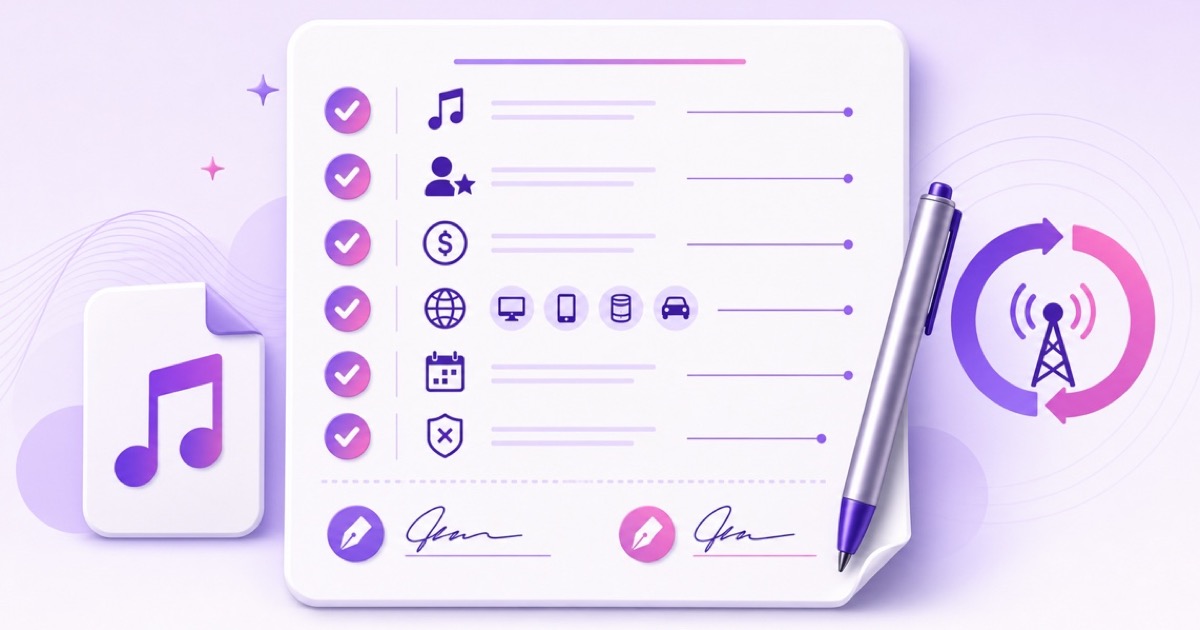
A simple permission record should identify:
- The exact work: track title, version, artist name, and the supplied audio file.
- Who owns what: confirmation that the signer controls the recording and can authorise the composition, or details of any other rightsholder whose approval is needed.
- The permitted use: non-exclusive use inside a pre-recorded programme loop delivered as a continuous YouTube live stream.
- Commercial scope: whether channel monetisation, sponsor mentions, clips, and promotional posts are allowed.
- Duration and territory: the start date, end date or ongoing term, and where the stream may be available.
- Credit: the artist name, track link, and wording that should appear in the description.
- Claims and exit: a contact for Content ID conflicts, a reasonable takedown process, and what happens to already rendered programmes if permission ends.
Keep the signed document, email thread, final audio file, and licence version together. If a distributor controls Content ID, ask the artist to arrange channel allowlisting or provide a claims contact before launch. For royalty-free catalogues, read the source licence rather than a reposted summary and confirm that monetised, repeated, live-loop use is expressly permitted.
For the broader difference between a claim, a takedown, and a strike, read the honest guide to copyright strikes on 24/7 loops. Never launch first and treat a claim as your licensing test.
Talk is your superpower
Music can set a mood; local talk gives the station a reason to exist. Your own script and recording are the rights-clean core of the programme. You can make a compelling hour even with a modest approved music library because the voice layer changes every week.
Useful recurring segments include a concise city-news roundup written in your own words, weekend event picks, short interviews with local artists, neighbourhood history, food-street reviews, college-festival notes, and public-service information from primary sources. Report facts; do not lift another broadcaster's audio, article narration, news montage, or interview clip. When a guest joins, get permission to record, edit, rebroadcast, monetise, and promote the interview.
Keep each segment specific. “Five things happening in Indore this weekend” is more useful than ten minutes of generic chatter. Mention the date inside time-sensitive updates so an old segment cannot sound current after the calendar changes. Remove expired event blocks before the next loop render.
Hindi, English, and the city's everyday language can coexist naturally. A short Hinglish link between two indie tracks often feels more local than a forced all-English radio voice. If you already publish long conversations, the workflow in turning a podcast into 24/7 live radio can help you repurpose only episodes and clips you control.
Build the broadcast day
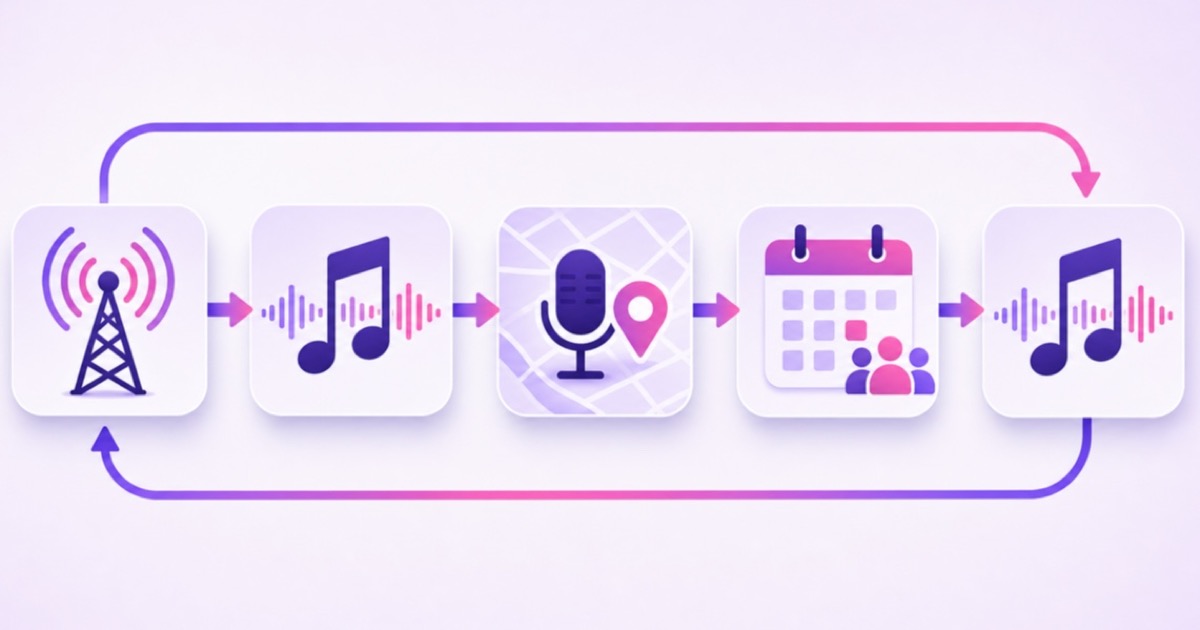
Start with a two-to-three-hour “broadcast day,” not a pile of unrelated files. Record your own station ident and short sweepers, then alternate music and talk so the listener never waits too long for either. Render the sequence as one dependable MP4 and loop that master.
| Block | Example duration | Purpose |
|---|---|---|
| Opening ident and welcome | 2 minutes | Name the city, date range, and recorded format |
| Approved local music A | 30 minutes | Set the station's sound |
| City roundup | 10 minutes | Deliver timely local value |
| Approved local music B | 35 minutes | Feature a different mood or scene |
| Local artist interview | 15 minutes | Add voices and cross-promotion |
| Approved local music C | 30 minutes | Return to uninterrupted listening |
| Events or food-street guide | 10 minutes | Give viewers a reason to check back |
| Approved local music D | 35 minutes | Close with a strong music block |
| Closing and seam | 3 minutes | Credit artists and lead smoothly to the opening |
This example totals two hours and fifty minutes. It is a structure, not a quota. Use fewer tracks if that is all you have cleared, and never repeat one artist so heavily that the programme becomes misleading or exhausting.
Dayparts make the station feel intentional. A morning version can favour city updates and lighter tracks; an evening version can lead with interviews, gig notes, and a longer music run. Publish the timetable in the channel description and follow it. The detailed 24/7 stream scheduling guide covers how to make those expectations dependable.
Production checklist
- Record voice in a quiet, soft-furnished room with the microphone position fixed. Listen for fans, traffic, clipping, and harsh sibilance.
- Edit music and speech to a consistent perceived level. Test on phone speakers and headphones; an ident should not jump out painfully after a song.
- Use original or licensed visual material. A simple city illustration, track-credit cards, and a subtle waveform are enough; avoid unlicensed news footage and brand logos.
- Export a consistent 1080p H.264 video with AAC audio. Watch the final minutes followed immediately by the opening to catch both visual and audio loop seams.
- In YouTube Studio → Create → Go live → Stream, create the broadcast and copy its stream details into your streaming service. Keep the stream key private.
- Run an unlisted test through the full transition back to the beginning. Check credits, dates, audio, links, and the live control-room health indicators before switching public.
A cloud loop keeps your laptop and home connection out of the critical path. With StreamNeo, the practical pattern is one city station on one slot: upload the finished broadcast day, connect the YouTube destination, and manage routine checks from your phone. Refresh the programme when local information changes rather than leaving last month's guide inside an always-on stream.
The local growth angle
City-name search intent is your advantage. Put the city and the format near the front of the title, then describe the actual mix. Examples include “Indore ka apna online radio | Local indie music + city updates” and “Pune local radio live | Independent artists, events and street-food talk.” Do not add “FM” or a frequency unless you operate the corresponding licensed broadcast service.
Give every featured artist a useful promotion kit: their scheduled block, a clean stream link, one approved visual, and the description credit. Their share introduces the station to a genuinely local audience; your interview or track slot introduces the artist to listeners who arrived for the city. That exchange works only when credits and timing are accurate.
Use community posts for this week's guests, event changes, and listener prompts. Measure returning viewers, concurrent-viewer patterns by hour, clicks on credited artist links, and which talk chapters retain attention. Change one programming variable at a time so you can interpret the result.
Local niches usually grow through repeated personal connections, not an instant viral wave. A smaller group that recognises the RJ voice and trusts the event guide is a stronger foundation than unrelated traffic attracted by a commercial song you were never allowed to stream.
Money and sustainability
The cleanest early revenue product is a host-read local sponsor mention recorded into a relevant talk block. Define exactly what the sponsor receives: for example, one clearly disclosed mention in each programme cycle for a stated date range, a description link, and a simple report of observable link clicks or code uses. Do not promise footfall or sales you cannot measure.
YouTube requires creators to declare paid placements, sponsorships, endorsements, and other commercial relationships; its policy explicitly applies to live streams. In YouTube Studio, open the broadcast's details, go to the additional options or content-declaration area, and select “My video contains paid promotion like a product placement, sponsorship, or endorsement.” Then save the change. YouTube also says creators and sponsors remain responsible for any additional disclosure duties in their jurisdiction. Check the current YouTube paid-promotion guidance whenever you add or renew a sponsor.
Make the relationship clear inside the recorded segment too. A natural line such as “This city-events update is sponsored by…” is better than hiding the arrangement. Do not splice in advertiser-supplied pre-roll, mid-roll, or commercial-break videos: YouTube distinguishes integrated host-read sponsorships from third-party ads that duplicate formats it sells itself.
Artist promotion can be another engine, but keep the economics visible. If an artist pays for an interview, featured rotation, or launch special, document the arrangement, secure the same music permissions, and label the paid relationship. Never present bought rotation as an independent editorial recommendation.
Price offers from your real costs: research and recording time, editing, artwork, rights administration, programme updates, and the streaming slot. Keep the first format small enough to refresh consistently. When the pilot programme, permissions folder, and unlisted test are ready, Start free — 24-hour trial, no card.
FAQ
Do I need a radio license for a YouTube station?
You do not need a radio-spectrum licence merely to deliver a YouTube live stream because it is an internet video service, not an FM or AM transmission. Music rights, advertising disclosures, privacy, and other applicable laws still apply in full. Get local professional advice if your operation goes beyond a simple creator channel.
Can I play Bollywood songs?
Not without the necessary permissions from the relevant rightsholders. A streaming subscription or purchased track is not a rebroadcast licence. For a realistic starter station, use music you created, tracks directly cleared in writing with local or independent rightsholders, or a catalogue whose terms explicitly permit monetised continuous live loops. Music producers can also follow this 24/7 beat-radio playbook.
What makes a city station grow?
The local talk layer. Timely city roundups, original interviews, event guides, and bilingual personality give viewers a reason to return; a generic music loop does not. Pair that voice with accurate city-name packaging, artist cross-promotion, regular programme refreshes, and music you are clearly allowed to use.