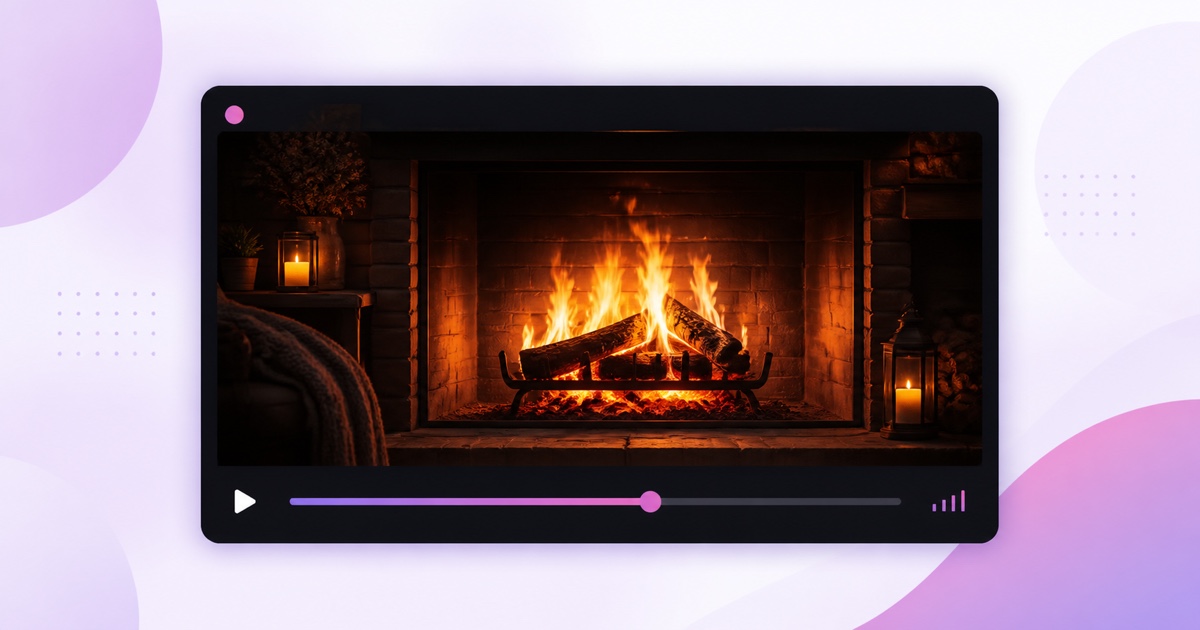
A good fireplace channel does not ask viewers to keep looking at it.It quietly makes a room feel warmer while someone reads, works, hosts dinner, or falls asleep.That background role is exactly why the format can hold attention for hours—but only when the loop feels natural enough to disappear.
The winning setup is not simply “fire.mp4 on repeat.” You need footage you can legally loop, crackle that does not expose the edit, a picture that works on a television, and a seasonal plan for the months when fireplace demand cools.This playbook covers the complete system without pretending it is a year-round goldmine.
Why fireplace content retains
A fireplace live stream 24/7 behaves more like TV-replacement content than a normal creator video.Many viewers put it on a living-room screen and let it shape the space.They are not waiting for a plot point; they want a stable visual and audio environment that does not interrupt the room.
That changes the creative goal.A dramatic camera move, frequent scene change, animated subscribe prompt, or loud music transition may earn attention in a short upload, but it breaks the spell in an ambience stream.The strongest experience is steady: a convincing flame, comfortable contrast, clean crackle, and almost nothing that demands a response.
Retention also depends on expectation.A title such as “Cozy Fireplace for Reading and Sleep” tells viewers exactly where the stream fits.The thumbnail, title, visual, and sound should make the same promise.A rustic hearth paired with nightclub-style music creates friction, even if both assets are technically good.
Seasonality is part of the business, not a flaw to hide.Fireplace viewing usually rises in colder months and softens when evenings become warmer.Treat October through February as the core fireplace window for much of the northern hemisphere, then check your own audience geography and analytics.A summer valley is a programming signal, not proof that the channel has failed.
Source your fire
The cleanest source is footage you shoot yourself.Use a sturdy tripod, frame wider than you think you need, and record several uninterrupted 20–30-minute takes.Lock focus, exposure, and white balance so the camera does not “breathe” when the flame brightens.Record at the resolution you actually plan to deliver, with enough detail left after any crop.
Real fire needs real safety.Use a properly maintained fireplace, keep the camera and cables outside the heat and spark zone, preserve ventilation, and have a responsible adult monitor every take.Never rearrange burning logs for a prettier shot.Let the fire settle, start recording, and make safety more important than continuity.
Before packing the camera away, review the files on a larger screen.Look for focus drift, clipped highlights in the hottest flame, dark areas crushed into featureless black, reflections of crew, and accidental background movement.Capture several minutes of the room before and after the main burn; those quieter moments can make smoother transitions.
If you license footage, the licence must explicitly fit the use.“Royalty-free” alone is not enough.Confirm that the terms permit commercial use, editing, repeated looping, continuous live distribution, your intended platforms and territories, and combination with your audio.Save the invoice, licence text, asset page, and date in one rights folder.
- Use: commercial or monetized streaming must be allowed.
- Format: continuous live use and looping must not be excluded.
- Edits: cropping, colour work, sequencing, and audio replacement should be permitted.
- Proof: keep a copy of the terms that applied when you downloaded the asset.
Never lift a loop from another channel, remove its watermark, or assume that an upload is reusable because it has no visible copyright notice.If you want to expand beyond the hearth, the same ownership discipline applies to rain, nature, and ambience loops.
The audio layer
Viewers will forgive a modest visual before they forgive artificial sound.Repeated crack patterns, a sudden volume jump, or one loud pop arriving at the same interval reveals the loop immediately.Once someone hears the seam, the room stops feeling natural.
For an original recording, place the microphone where it captures detail without being exposed to heat.Monitor through headphones, leave headroom for sharp pops, and record multiple long passes.Listen for fans, traffic, voices, camera handling, and electrical hum.A clean crackle-only track is simple, useful for sleep and reading, and much easier to clear than a music bed.
Build the audio master independently from the picture.Choose sections with a consistent noise floor, make gentle crossfades away from prominent cracks, and audition the join repeatedly on headphones and speakers.Do not “improve” the fire with aggressive compression that turns every pop into an alarm.
Jazz is tempting because it signals “cozy café,” but it adds a rights problem.You may need permission for both the recording and the underlying composition, plus terms that cover live, continuous, repeated use.A subscription music plan is not automatically permission for an always-on channel.If music is central to the concept, work through the rights checklist in the city radio-style channel playbook; otherwise, authentic crackle is the cleaner creative choice.
When in doubt, remove the track rather than hoping an automated claim never arrives.Rights uncertainty is not an audio strategy.
Seasonal programming
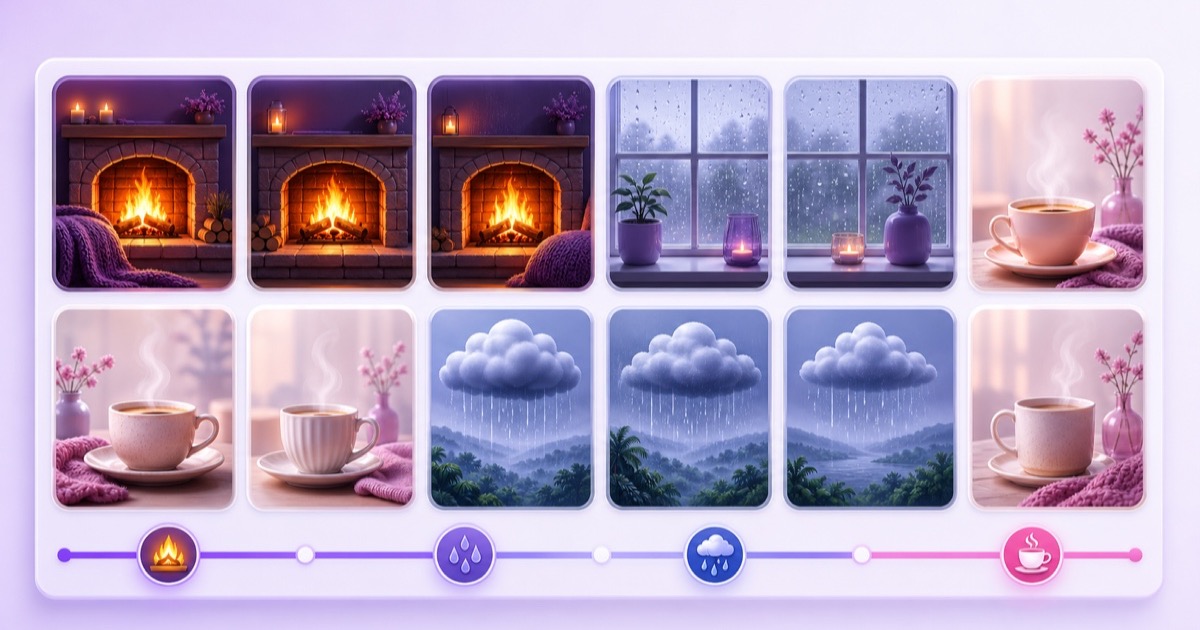
Plan the channel as a calendar instead of forcing the same fireplace scene through every month.The exact timing depends on audience location, climate, and search behaviour, so use this as a starting hypothesis and adjust from your own data.
| Period | Primary programme | Creative treatment |
|---|---|---|
| October–February | Fireplace and winter ambience | Warm hearths, longer nights, crackle-first sound |
| March–May | Cozy café or rain-on-window | Lighter rooms, softer warmth, no winter-only promise |
| June–September | Rain and monsoon ambience | Window rain, covered veranda, thunder used sparingly |
For an India-focused audience, monsoon windows can bridge the warmer part of the year naturally.Reuse the channel’s promise—comfortable background ambience—without pretending that a blazing winter hearth fits every city in June.The guide to scaling rain videos into a 24/7 channel explains how to turn longer rain assets into a rotation.
You have an honest fork.One channel can rotate fireplace, rain, and café scenes under a broad “cozy ambience” identity; this concentrates the audience but requires careful seasonal branding.Separate channels give each niche a clearer promise, but divide your upload library, analytics, and operating attention.Read the multi-channel strategy before opening three destinations at once.
Optimize for TV casting
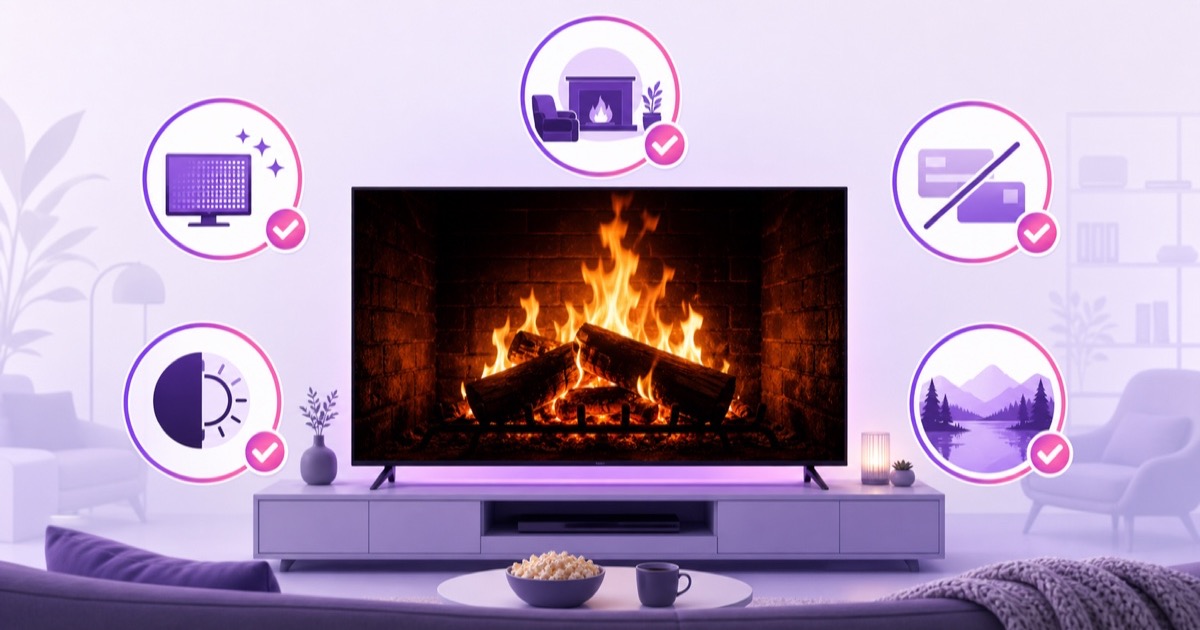
Design for the sofa, not just the phone preview.Use 1080p as the minimum delivery target for a living-room stream, provided the source is genuinely sharp enough.Fine grain, crushed shadows, noisy dark walls, and over-sharpened logs become much more obvious on a large display.
Grade the scene in a dim room.Keep the flame bright but not painfully white, retain texture in the surrounding brick or wood, and avoid rapid brightness swings.Test at low television brightness as well as normal settings.A cozy scene should not flash the room every time a log flares.
- Keep overlays minimal: a small, static mark is less distracting than animated banners.
- Avoid small text: it will be unreadable across a room and unnecessary for ambience.
- Protect the frame: keep essential visual details away from the extreme edges.
- Check compression: smoke, embers, and dark gradients can expose blockiness.
- Match the claim: never put “4K” in the title or thumbnail when the stream is 1080p.
Create an unlisted test in YouTube Studio → Go Live → Stream, then watch it on an actual TV for at least one complete transition.Check the phone experience too, but let the television test decide whether the scene is comfortable at room scale.If you later explore a brighter hospitality look, compare the composition with this restaurant and café ambience playbook.
Retention mechanics and measurement
Aim for a programme loop of at least 60 minutes so repetition is not constantly visible.That does not require one perfect hour-long take.You can sequence several 20–30-minute recordings from the same setup, using natural low-action moments for picture transitions and independent audio crossfades.Do not mirror or reverse flames as a shortcut; unnatural smoke and sparks are easy to notice.
Watch the finished hour twice: once with headphones, then on a TV at normal room volume.Note repeated flare shapes, logs that jump position, smoke that changes direction, duplicated sharp pops, and sudden ambience-level changes.Fix the earliest obvious seam first and repeat the test.
After launch, track hourly concurrent viewers rather than judging the channel from one daily total.In YouTube Studio, open the stream’s Analytics view and compare similar hours and days.Fireplace audiences can follow evening, weekend, weather, and seasonal patterns, so a Tuesday afternoon should not be compared casually with a cold Sunday night.
Keep a simple change log with date, scene, audio master, title, thumbnail, and hourly concurrency notes.Let a version run long enough to form a usable baseline, then change one element at a time.A practical rhythm is a monthly visual refresh, with urgent changes only for rights, safety, or technical problems.Changing the title, scene, audio, and thumbnail together destroys the lesson.
Seasonal channels also benefit from flexible operating cost.You can use StreamNeo at ₹49/day while testing a winter concept, then move to a monthly plan once the channel has proven it deserves a permanent slot.Review the current pricing options before choosing.When your rights-cleared hour is ready, start free — 24-hour trial, no card.
FAQ
Can I title it 4K if I stream 1080p?
No.Use the resolution you actually deliver in the title, thumbnail, and description.Upscaling or placing a 1080p stream inside a 4K project does not make the source genuinely 4K, and a misleading claim weakens viewer trust.
Where do I get fireplace footage?
Shoot your own with a safe, monitored fireplace setup, or license footage whose written terms permit commercial, edited, looped, continuous live use on your chosen platforms.Keep the licence and receipt.Do not copy another channel’s loop.
Is fireplace content year-round?
It can stay available year-round, but demand is normally more seasonal than rain or general relaxation ambience.Expect stronger winter interest, watch your audience geography, and rotate toward rain, monsoon, or cozy-café scenes when your data shows the fireplace cooling.